
Sep 17, 2026Engineering Whitepapers
PVC Injection Molding: Mold Design, Venting and Processing Challenges
Learn the key mold design and processing challenges of PVC injection molding, including venting, temperature control, gate design, degradation risks and tooling considerations.
PVC Injection Molding: Mold Design, Venting and Processing Challenges
PVC can be injection molded into a wide range of technical and functional parts, but it is less forgiving than many standard thermoplastics. A successful PVC molding process depends on disciplined control of heat history, residence time, venting, gate and runner design, mold condition and process stability.
For mold buyers, the important question is not simply whether PVC can be molded. The real question is whether the mold and process are designed to manage PVC's narrower processing window without creating unnecessary degradation, burn marks, gas-related defects or unstable filling.
PVC tooling should be evaluated as a complete system: part design, mold design, venting, material behavior and process control must work together.
Why Does PVC Injection Molding Require Tighter Process Control?
PVC has different processing characteristics from commonly molded materials such as PP, PE or ABS. Excessive thermal exposure or unnecessarily long residence time can increase the risk of material degradation, while insufficient venting can make trapped gases and burn marks more difficult to control.
This makes PVC injection molding particularly sensitive to the following areas:
- Melt temperature and heat history
- Material residence time in the barrel and hot areas
- Mold venting efficiency
- Gate and runner geometry
- Filling balance
- Mold surface condition
- Part release and runner removal
- Cleaning and maintenance discipline
-
A part that appears geometrically simple may still require careful tooling and process development if the material is PVC.
Venting Is Critical in PVC Mold Design
Effective venting is one of the most important considerations in PVC mold design. Air and process gases must be able to escape as the melt fills the cavity. Poor venting can contribute to burn marks, incomplete filling, unstable surface quality and inconsistent molding behavior.
Venting should be evaluated around likely end-of-fill areas, deep features, ribs, flow-front meeting points and other locations where gas can become trapped.
For PVC molds, venting is not a secondary detail; it is part of the core filling strategy.
2. Gate and Runner Design Must Support Stable Filling
The gate and runner system should help the cavity fill predictably without creating unnecessary shear, excessive heat or poorly balanced flow. Gate location also affects weld lines, trapped gas, filling distance and how easily the part can be removed after molding.
For multi-feature technical parts, the mold designer should consider how the melt reaches different sections of the cavity and whether the runner arrangement supports stable, repeatable filling.
The correct gate strategy depends on part geometry, PVC grade, wall thickness, appearance requirements and production expectations. There is no single gate design that is suitable for every PVC component.
3. Temperature and Residence Time Require Tight Control
PVC is sensitive to excessive thermal exposure. Processing therefore requires careful control of material temperature and residence time rather than simply increasing temperature to improve flow.
A stable process should avoid unnecessary overheating while still providing sufficient filling capability for the specific part geometry.
- Keeping material exposure time under control
- Avoiding excessive thermal history
- Maintaining consistent machine settings
- Preventing unnecessary material stagnation
- Monitoring changes in color, odor or surface condition that may indicate processing instability
4. Mold Material and Corrosion Considerations
If PVC is exposed to excessive heat, thermal degradation can produce corrosive by-products. For this reason, mold material selection, surface protection, venting and maintenance should be considered according to the specific PVC grade and production conditions.
The correct tooling solution depends on the PVC formulation, expected production volume, mold life target, surface requirements and maintenance environment.
Rather than selecting mold steel only by price or nominal hardness, the tooling plan should consider corrosion resistance, polishing requirements, maintenance frequency and the expected production conditions.
5. Common PVC Injection Molding Problems
Several molding problems can become more difficult to manage when the mold and process are not well matched to PVC.
Burn Marks
Burn marks may be associated with trapped gas, local overheating or unstable filling conditions. Venting and process setup should be reviewed together rather than treating the visible defect alone.
Short Shots
Incomplete filling may result from flow restriction, premature material freezing, insufficient venting or an unsuitable gate and runner strategy.
Material Degradation
Excessive heat history or long residence time can negatively affect PVC processing stability. Process control should focus on achieving filling without unnecessary thermal exposure.
Sticking or Difficult Release
Part geometry, surface condition, draft, cooling and ejection design can all affect part release. PVC mold design should account for release behavior early in the DFM stage.
6. What Should Be Reviewed During DFM for a PVC Part?
Before tooling release, a PVC project should be reviewed from both part-design and mold-design perspectives.
- Wall thickness and flow length
- Sharp transitions and material accumulation
- Draft and release conditions
- Gate location
- Runner layout
- End-of-fill venting
- Rib and boss geometry
- Threaded or side-action features
- Surface requirements
- Material grade
- Expected annual volume
- Mold life target
This review helps identify risks before steel cutting, when changes are still less expensive and easier to implement.
Real Trial Reference: PVC Technical Part with Runner Attached
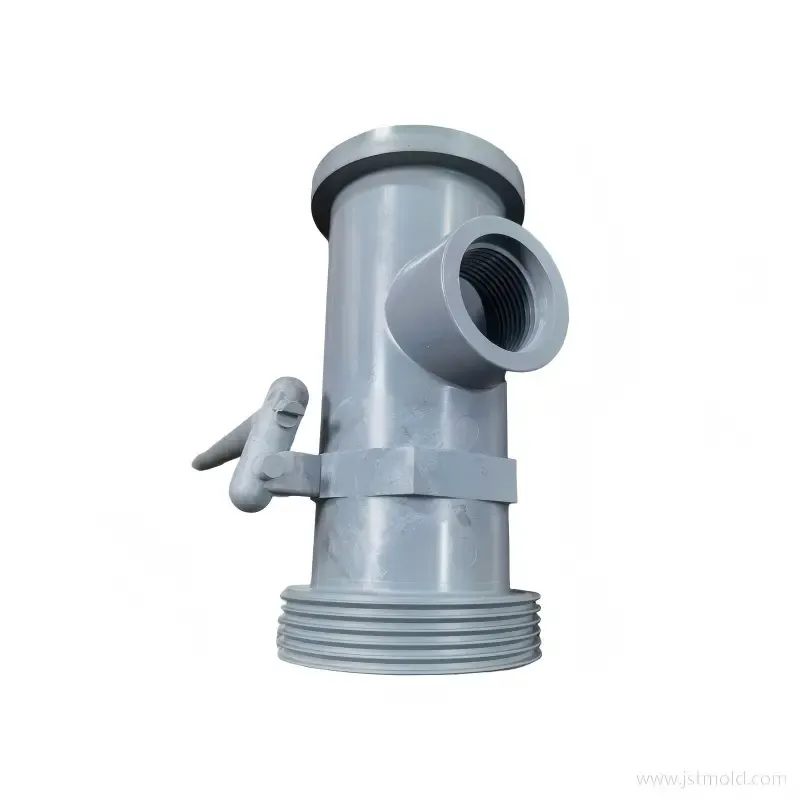
PVC Injection Molded Trial Sample with Runner
The trial sample below shows a PVC technical component directly after molding, with the runner still attached. Leaving the runner visible provides a useful engineering reference because it shows the part before trimming and helps illustrate the relationship between the molded component and its feed system.
The part includes a cylindrical body, threaded geometry and a side feature, making it a useful example of the type of technical PVC component that requires coordinated tooling and process control.
PVC injection molded trial sample with runner attached before trimming.
How JST Mould Supports PVC Tooling Projects
JST Mould supports PVC tooling projects through engineering review, DFM, mold design evaluation, tooling coordination, trial assessment and qualified manufacturing resources with relevant PVC processing experience.
Our role is to help customers evaluate whether the part, mold structure and production approach are compatible before committing to tooling.
Support can include:
- DFM review
- Mold structure evaluation
- Gate and runner review
- Venting strategy
- Mold material planning
- Tooling manufacture coordination
- Mold trial and sample evaluation
- Process troubleshooting support
The objective is not simply to build a mold, but to reduce avoidable tooling and processing risk before production.
Technical Summary
Item | PVC Tooling Consideration |
|---|---|
Material | PVC |
Key Process Concern | Thermal exposure and residence time |
Mold Design Focus | Venting, gate and runner design |
Tooling Consideration | Corrosion resistance and maintenance |
Typical Risks | Burn marks, degradation, short shots, sticking |
DFM Focus | Flow path, venting, release, wall thickness |
JST Support | DFM, mold review, tooling and trial coordination |
What Information Should You Send for a PVC Mold Quotation?
For an initial PVC tooling review, the following information is useful:
- 3D CAD data
- 2D drawing if available
- Exact PVC material grade
- Part dimensions
- Wall thickness
- Surface and appearance requirements
- Annual production volume
- Expected mold life
- Any existing molding or quality requirements
If the project is still at an early stage, reference drawings and available technical information can be reviewed first to identify what additional data will be required.
Need Support for a PVC Injection Mold?
If you are developing a rigid or technical PVC component, send us your 2D/3D data, material grade and production requirements. JST Mould can review the tooling and molding feasibility before quotation.
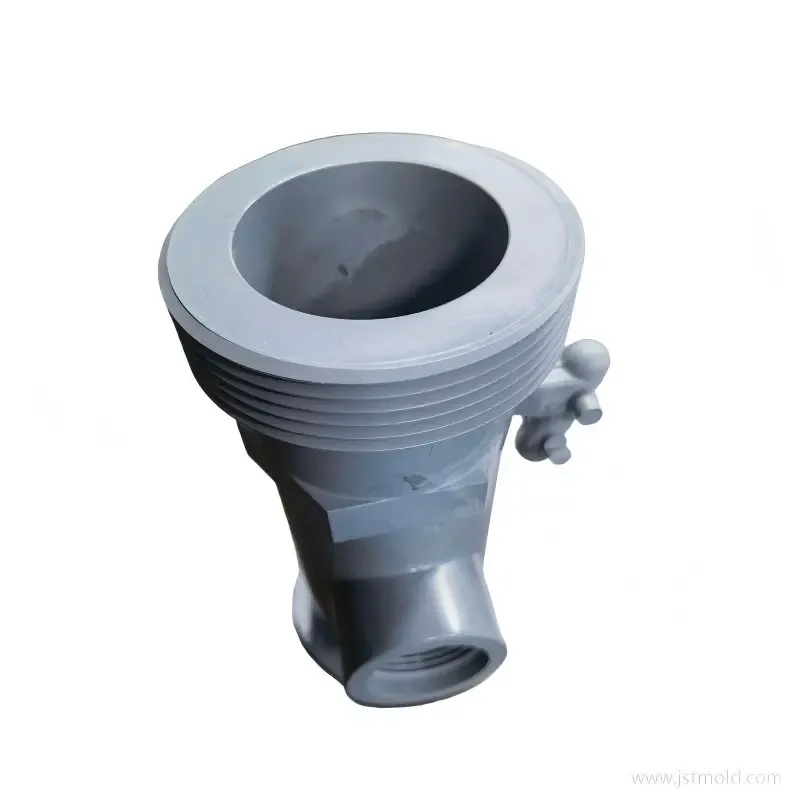
Side view of a PVC molded technical part showing threaded and side features.
FAQ
Can PVC be injection molded?
Yes. PVC can be injection molded successfully, but the process generally requires tighter control of temperature, residence time, venting and mold conditions than many common thermoplastics.
Why is venting important in PVC injection molding?
Venting allows trapped air and process gases to escape during filling. Poor venting can contribute to burn marks, incomplete filling and unstable surface quality.
Does PVC require a special injection mold?
A PVC mold is still an injection mold, but its design should account for PVC-specific processing considerations such as venting, thermal sensitivity, corrosion resistance, gate and runner design, maintenance and material behavior.
What causes PVC to degrade during injection molding?
Excessive thermal exposure and unnecessarily long residence time can increase the risk of PVC degradation. Stable processing aims to achieve adequate filling without excessive heat history.
What information is required for a PVC mold quotation?
Useful information includes 2D/3D part data, exact PVC material grade, wall thickness, dimensional requirements, surface requirements, expected production volume and target mold life.