
Jul 20, 2026Tier-1 Success Stories
High-Performance PPS Molding: Achieving 51% Cycle Time Reduction via Advanced Thermal Engineering
PPS GF40 case study: How JST used 20mm baffles and Reynolds number > 4000 logic to cut cycle time from 45s to 22s for a Tier-1 European partner.
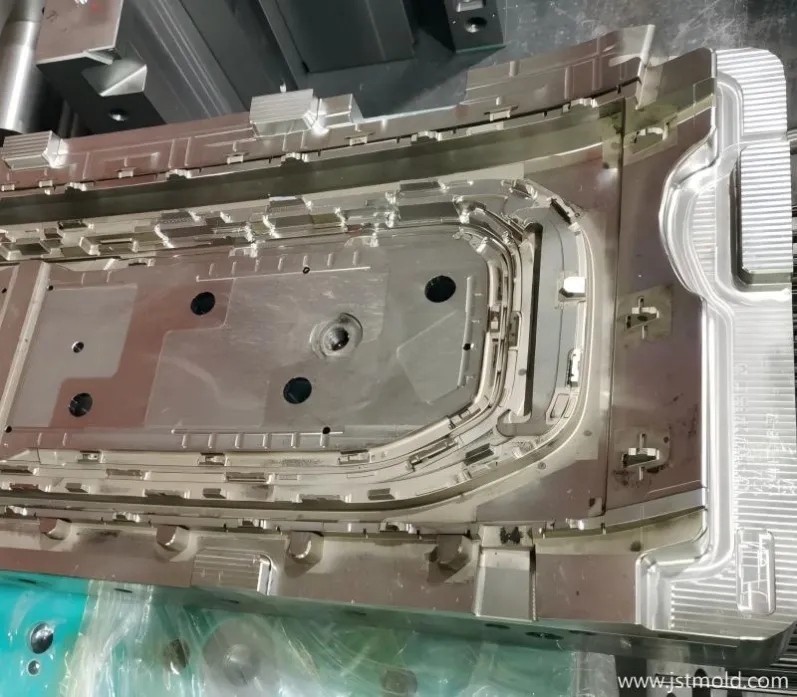
Beyond the Iron: How JST Mould Achieved a 50% Cycle Time Reduction for High-Performance PPS GF40 Components
High-precision cavity inserts for PPS GF40 components, featuring sub-micron sharp rib definition and HSM surface integrity.
Precision Execution: Sub-micron rib definition achieved via 5-axis HSM.
EXECUTIVE SUMMARY
In the competitive Tier-1 automotive landscape, mold performance is no longer measured just by the quality of the part, but by the efficiency of the production cell. This case study details how JST Mould addressed the dual challenges of high-abrasive material processing (PPS 40% Glass Filled) and aggressive cycle time targets, delivering a T1 success that surpassed European industry benchmarks.
THE CHALLENGE: PRECISION VS. PRODUCTIVITY
A prominent European partner approached JST with a complex internal component project. The existing benchmark for this geometry was a 45-second cycle time, primarily due to the slow cooling phase required to prevent warping in glass-filled polymers.
Key technical hurdles included:
Material Erosiveness: PPS GF40’s high glass fiber content causes rapid wear on conventional gate inserts.
Geometry Complexity: Sharp internal ribs requiring sub-micron definition.
Thermal Bottleneck: Inefficient cooling in the core-side bosses leading to cycle time jitter.
THE JST ENGINEERING APPROACH
- REINVENTING THE THERMAL MAP Standard cooling channels were insufficient for the target 25-second cycle. JST’s engineering team utilized thermal simulation to design a "Flow-Balanced" cooling system. By integrating high-conductivity copper alloy inserts in critical heat-concentration zones and ensuring turbulent flow (Reynolds number >4000) in all circuits, we achieved a 40% faster heat dissipation rate compared to standard designs.
Here is Our original engineering plan for a complex project.
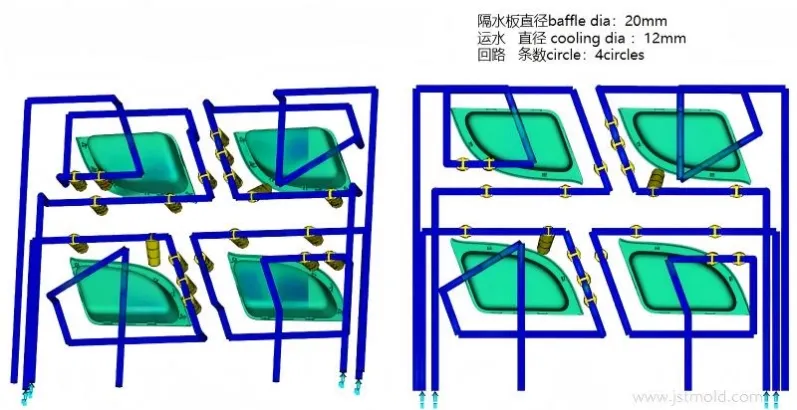
Thermal Mastery: Engineering turbulent flow to stabilize cycle times at 22 seconds.
- HSM VS. TRADITIONAL EDM: THE INTEGRITY ADVANTAGE
To meet the "sharp rib" requirement on the outer diameter, JST opted for 5-axis High-Speed Milling (HSM) at 30,000 RPM using diamond-coated micro-cutters.
- Technical Benefit: This avoided the "White Layer" (re-cast layer) typically left by EDM, which can be a point of structural failure in high-stress automotive parts.
- Result: A crisper edge definition and improved polymer flow during injection.
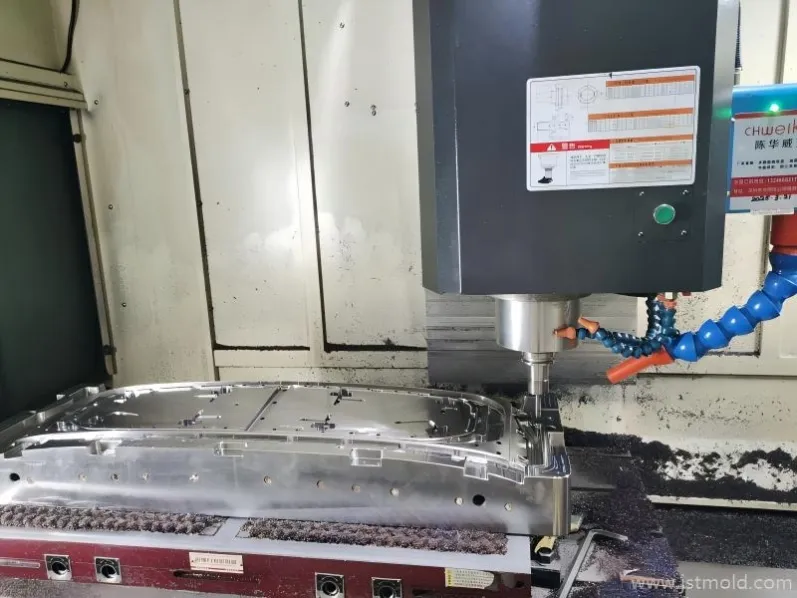
Surface Integrity: Eliminating the heat-affected zone via precision high-speed milling.
- STRATEGIC DE-GASSING AND VENTING High-speed injection is mandatory for thin-wall PPS parts but often leads to gas burning. JST implemented a perimeter venting strategy with a 0.015mm clearance, combined with vacuum-assisted venting in deep pockets. This ensured zero burn marks even at maximum injection velocity.
THE QUANTIFIABLE RESULTS
- Cycle Time: Reduced from 45s to 22s (51% improvement).
- T1 Validation: 100% dimensional compliance on the first trial.
- Production Stability: Zero flash or short-molds during the 4-hour high-speed validation run.
CONCLUSION
At JST Mould, we believe that a mold is a production instrument, not just a tool. By focusing on the intersection of material science and thermal engineering, we help our clients maximize their Overall Equipment Effectiveness (OEE) from day one.
UPLOAD 3D DATA FOR FEASIBILITY REVIEW
Does your next project demand this level of engineering rigor?
Does your next project demand this level of engineering rigor?
Listen, we know the pressure of a Tier-1 launch. A 45-second cycle time isn't just "slow"—it’s a margin killer. High-abrasive resins like PPS GF40 shouldn't be your headache; they should be a solved problem in the DFM phase.
At JST Mould, we don't just "take orders." We de-risk your entire production cell. If you are tired of "good enough" tooling that fails under mass production stress, let’s have a technical conversation.