
Jul 21, 2026Precision Engineering & Tooling
DACH Tooling Standards: Engineering High-Cycle Molds with HRC 52-54 Stability for Tier-1 Markets
How JST Mould internalizes DACH standards for Tier-1 markets. Technical deep-dive into 1.2344 ESR steel validation, triple-tempering logic.
【Foreword】:
For manufacturers in the DACH region (Germany, Austria, Switzerland), the cost of a mold is secondary to the cost of production downtime. A single hour of line-stop in a Tier-1 facility can cost tens of thousands of Euros. At JST Mould, we don't just build tools; we engineer stability. Through our technical mapping with senior European consultants, we have developed a set of protocols designed to bridge the gap between Asian manufacturing speed and the uncompromising precision of Swiss and German engineering.
Metallurgy and Heat Treatment: The Science of HRC 52-54 Stability Specifying 1.2344 ESR (Electro-Slag Remelting) is only the first step. For high-cycle tools exceeding 1.0 million shots, the internal stress of the steel is the silent killer.
- Steel Validation: JST exclusively utilizes certified 1.2343/1.2344 ESR grades for all high-cycle applications to ensure superior polishability and resistance to thermal fatigue.
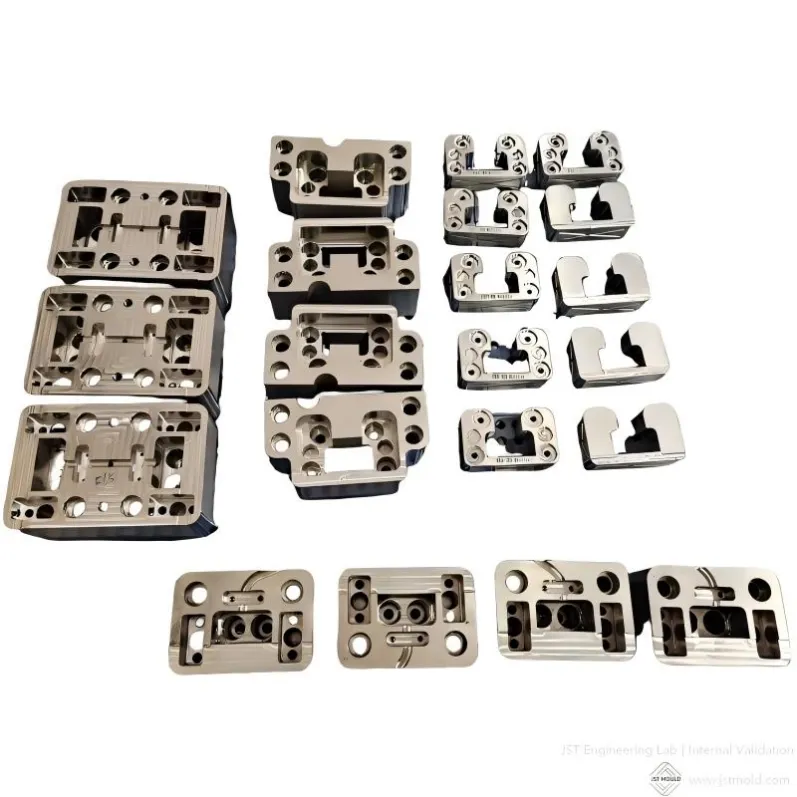
- The Triple-Tempering Protocol: Unlike standard quenching, JST enforces a mandatory triple-tempering cycle followed by a controlled sub-zero treatment. This process stabilizes the martensitic structure, locking the hardness at HRC 52-54 and reducing the risk of dimensional drift to less than 0.01mm over 500,000 cycles.
- Plating Deduction Logic: For components requiring subsequent electroplating (e.g., 0.05mm layers), JST utilizes advanced 3D surface offset calculations in the milling stage, ensuring the final assembly meets the tightest tolerances after the coating is applied.
Verified Stability: Precision inserts achieving <0.01mm drift after 500k+ cycles.
Advanced Thermal Dynamics: Eliminating the "Delta-T" Gap
Uniform cooling is the difference between a tool that works and a tool that performs. In complex multi-cavity molds, a temperature variance (Delta-T) of more than 5°C across the cavity surface leads to internal stress and warpage.
- Conformal Cooling Integration: JST utilizes 3D-printed conformal cooling channels in "Hot Spots" where traditional drilled lines cannot reach. This technique has proven to reduce cycle times by up to 20% while maintaining part geometry.
- Beryllium Copper Strategy: In areas requiring rapid heat dissipation, such as deep ribs or core pins, we integrate high-conductivity Beryllium Copper inserts, precision-fitted to the core. This proactive thermal management prevents localized overheating, which is the primary cause of premature gate erosion in PA 4.6 or PPA resins.
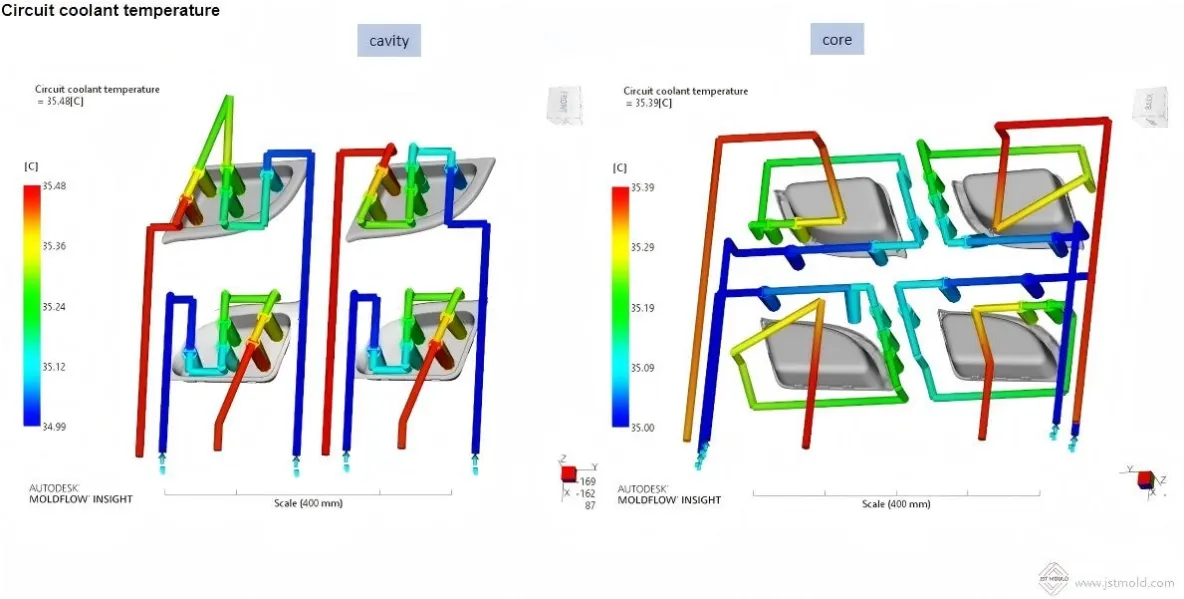
Thermal Dynamics: Achieving <2°C Delta-T variance to prevent thermal stress and warpage.
Active Venting and Gas Management for Technical Resins
Processing high-temperature materials like PA 4.6 (Stanyl) requires more than standard venting. Carbon buildup at the gates is the leading cause of tool degradation.
- Calculated Gas Discharge: JST engineers calculate the exact gas discharge volume based on the injection speed and material viscosity.
- Perimeter Venting Protocols(See our [2024 Technical Specification Protocol] for a detailed breakdown of our mandatory baselines.):
We implement perimeter venting with a 0.02mm tolerance—tight enough to prevent flash, but open enough to ensure zero gas traps. This ensures that T1 samples achieve A-Class surface quality immediately, without the need for manual rework.
Smart Mold Readiness: Industry 4.0 and Vertical Integration
Following the trends in Diepoldsau and Esslingen, modern production lines require tools that act as data nodes.
Sensor Integration: JST mold architectures are designed "Sensor-Ready." We provide standardized pockets and wiring channels for RJG or Kistler cavity pressure sensors.
Plug-and-Play Compatibility: Our tools are engineered to be compatible with automated assembly lines, featuring standardized clamping and interface layouts as per VDA guidelines.
Your Technical Partner in China
JST Mould provides the technical rigor of a Black Forest tool shop with the rapid-response agility of the Shenzhen ecosystem. We don't want your simple projects; we want the ones your current suppliers find too complex.
- Reach us by info@jstmould.com
- Request a Meticulous DFM Review for Your Next Complex Project
- Contact our Engineering Team for a Technical Benchmark Discussion