Jul 28, 2026Tier-1 Success Stories
Vetting Chinese Mold Suppliers: An Engineering Guide to Tier-1 Tooling Partnerships (2026 Edition)
9 expert tips to evaluate Chinese mold makers. From technical "quizzes" and DFM audits to 2026 quality standards for Tier-1 automotive sourcing.
Reader's Guide: How to find Chinese plastic injection mold suppliers?
This question may seem a bit cliché. After years of Chinese companies going global—especially guided by B2B platforms like Alibaba, Made-in-China, and Global Sources—finding suppliers has become easier, just as Alibaba says: it helps sellers and buyers find each other effortlessly. Many buyers who have cooperated with China already have their own successful ways of dealing with Chinese suppliers.
That said, based on my many years of experience in export-standard plastic injection molds, here are my personal views on how to find and evaluate a reliable Chinese injection mold manufacturer for cooperation.
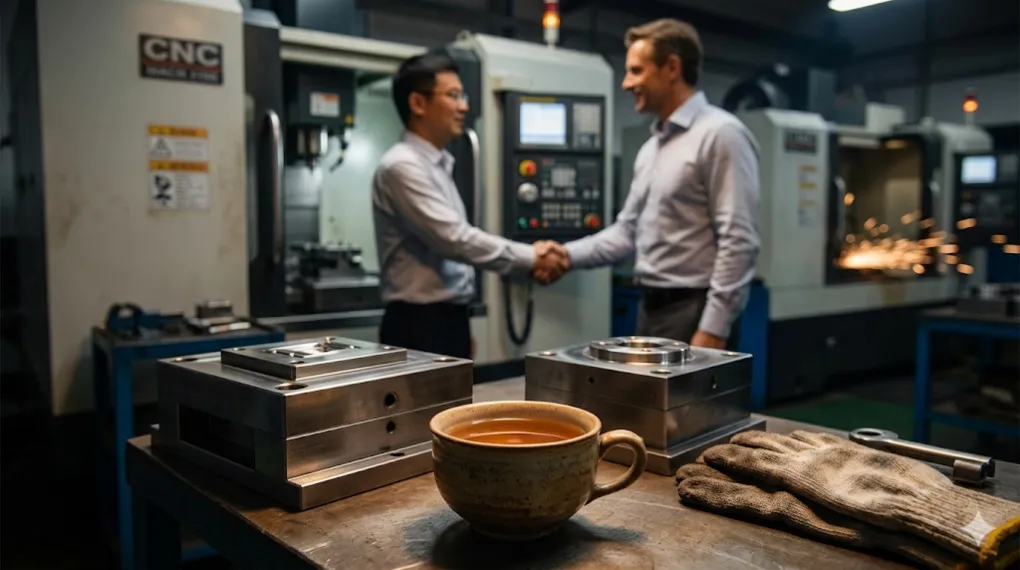
Seeing is Believing: Moving from digital screens to a professional handshake in the shop floor.
[Case Study]
How to Find a Reliable Chinese Injection Mold Manufacturer: 9 Practical Tips from an Export Expert
- Start with Initial Contact from Sales Representatives
How to verify Chinese mold suppliers? Many times, sales representatives reach out to potential overseas injection mold customers via email or cold calls. However, many customers ignore them, delete them, or send them straight to spam. Cold calls are often hung up on too. We have also practiced cold visits ourselves.
Only when customers truly need to find a Chinese plastic mold supplier will they consciously read these emails or answer the phone. As the email content and phone conversations deepen, you will gradually form an abstract impression of the mold supplier.
- Research Through Their Website and Social Media Platforms
Reliable Chinese injection mold manufacturers usually have their own official websites, as they understand the importance of independent site showcasing. However, many websites or independent sites are not very well made—sometimes because the team doesn’t know how to present themselves better. On the other hand, many small and medium-sized enterprises (SMEs) in the mold industry are relatively weak in operations and marketing.
Yet many of these SMEs have strong qualifications and real capabilities—they simply don’t focus much on platform promotion. Therefore, you can further verify them through their social platforms such as LinkedIn, XING, Facebook, Instagram, Twitter, YouTube, and others.
- Ask Professional Technical Questions and Evaluate Their Responses
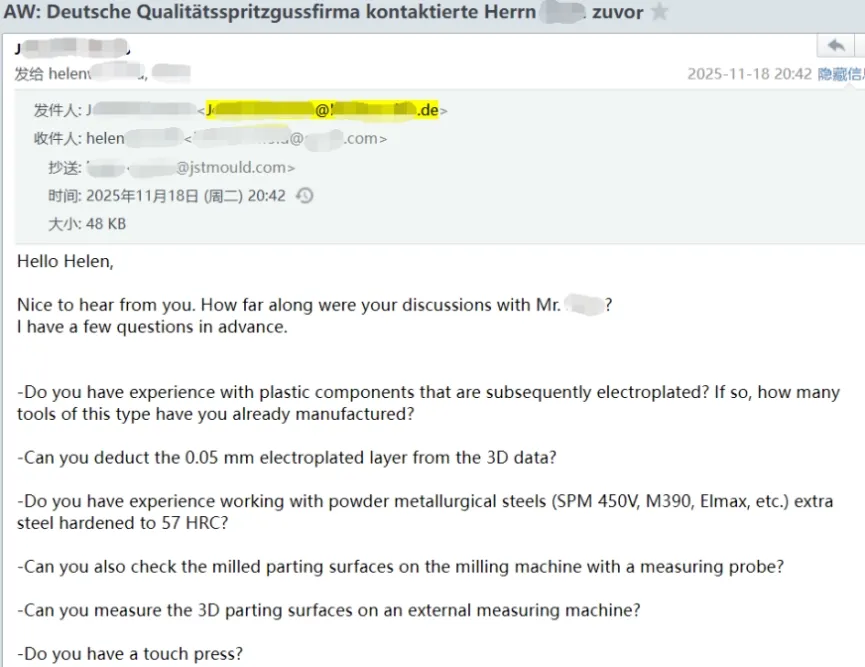
The Technical Quiz: Evaluating a supplier’s response to complex engineering requirements.
You received hundreds of cold emails, but how do you spot the one who actually knows their steel?
You can propose various professional questions based on your company’s specific needs and see how the Chinese mold manufacturer replies.
Here is an example from a new customer in 2025 who showed interest in us after initial communication (email screenshot).
In fact, this customer raised many questions, so the email was quite long—this is an excerpt. Similarly, below is an excerpt of our reply (email screenshot).
To spot a veteran supplier, you must look for data-backed evidence. At JST Mould, we provide precise solutions for complex requirements, such as a 0.05mm Plating deduction directly from 3D data. We don't just promise quality; we deliver a Steel Certificate and Heat Treatment Report (using premium steels like Groditz) for every critical insert. Furthermore, our validation isn't limited to the workshop floor—every complex geometry is verified on our high-precision CMM inspection machine to ensure absolute alignment with European engineering blueprints.
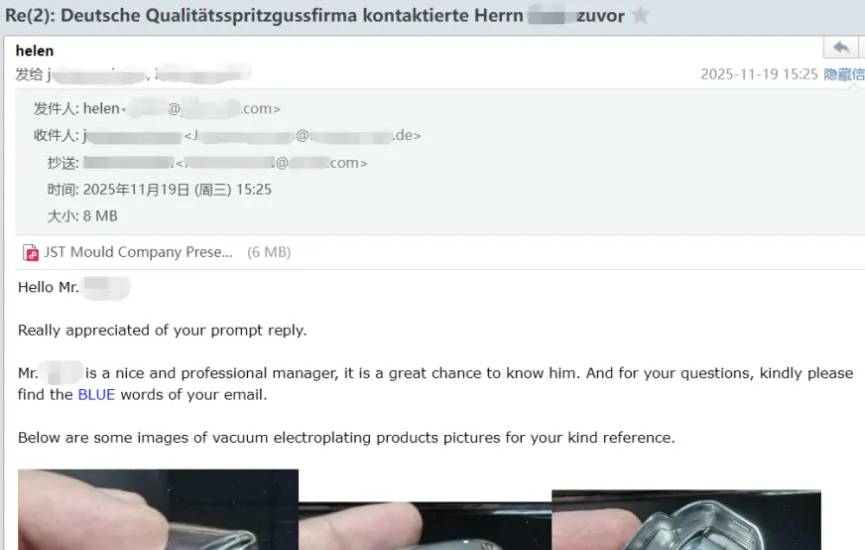
Initial Engagement: Building trust through professional communication and prompt technical feedback.
As shown in the following technical excerpt, we don’t just say 'yes'; we provide the exact engineering logic for electroplating compensation and steel heat treatment protocols.
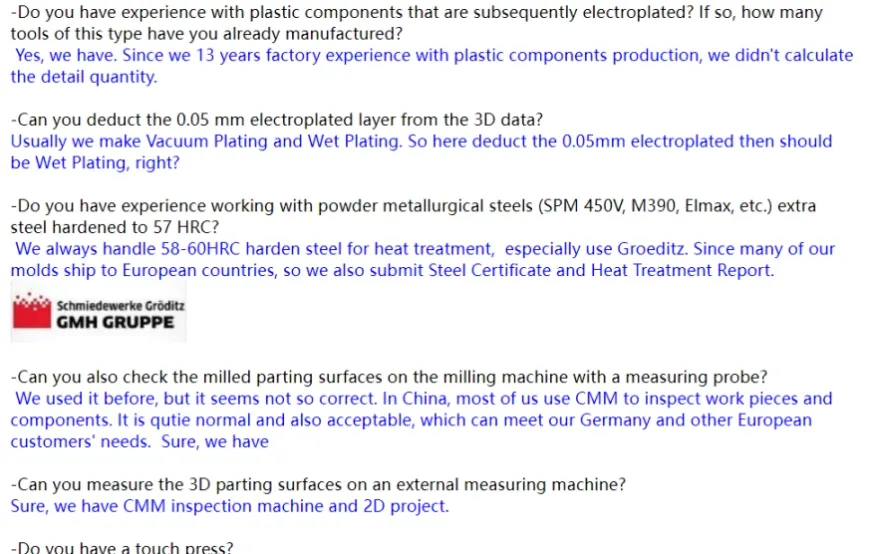
Technical Depth: Solving complex engineering hurdles with data-backed evidence and certificates.
- Review Real (Anonymized) Customer Feedback
You can ask for real customer reviews with key information mosaicked out to get a side understanding. During communication, requesting these is not difficult.
Taking us as an example, we highly value customer feedback. Especially for important or routine follow-ups, we always ask customers to share their opinions. The most important aspect is whether the molds, samples, or custom machined parts meet the customer’s requirements in quality, tolerances, and other aspects, and whether any issues exist. We attach great importance to quality and to customers’ usage feedback.
On the other hand, we can improve ourselves based on feedback from various customers across multiple dimensions.
Therefore, if you have found a potential high-quality Chinese injection mold supplier worth deeper communication, feel free to ask them to provide some customer reviews (with key information mosaicked). This way, neither side feels awkward, and the supplier can protect their clients’ information. The goal is simply to verify quality and service from the side.
- Conduct Online Meetings (Teams, Zoom, etc.)
Online meetings provide a good opportunity for customers to meet and talk directly.
Taking us as an example, after sending an RFQ and several rounds of quoting and communication, many customers invite us for an online meeting before formal cooperation. We welcome this very much, as it is another channel for customers to learn more about us.
Often, they want to understand our manufacturing process, quality control, FOT (First Out of Tool), mold delivery time, and other details. Especially for large or price-sensitive projects, an immediate online meeting is very necessary. Because we are confident in our quality, we mainly answer the customer’s questions or respond to temporary doubts on the spot. This helps eliminate concerns before cooperation.
- Visit the Factory in China in Person
The most direct way is to come to China and visit the factory. We have such customers too. Because seeing is believing—people trust what their eyes see and can directly feel the enthusiasm, leading to a more intuitive judgment.
Especially for custom injection molds, customers tend to be more cautious. Custom products involve significant time and money costs, unlike consumables. If the early DFM, communication, and design are not done well, the subsequent manufacturing can be problematic.
There’s an old Chinese saying: "Meeting once is worth more than a hundred emails." Some clients worry about the travel cost, but there is a profound difference between a screen and a handshake. When we sit around a conference table, savoring a cup of aromatic coffee or a fresh Chinese tea, we aren’t just talking business; we are building a bridge. In that moment, you can feel our sincerity. You’ve seen the sparks in our workshop; now you feel the heart of our team.
However, this is not mandatory. We have many customers who have never visited us once, yet we have maintained successful cooperation for many years. Therefore, you should consider your own conditions comprehensively.
- Observe Other Molds in the mold maker's Workshop During a Visit
When visiting a mold manufacturer’s workshop, you will often see many molds from their current customers. You can check the general structure, dimensions, materials used, and samples. This helps evaluate the manufacturer’s capabilities well—especially molds still in trial molding and their trial samples.
At this time, you can raise questions about these trial molds and samples and listen to the supplier’s responses. While the injection molding still under trial run stage, it can reflect and exposure many open points. This is a great chance. This further deepens your understanding of the Chinese injection mold manufacturer.
- Test the Design Department with High-Difficulty Questions
You can go directly to the design department and test them with challenging design problems closely related to your company’s quality requirements and production standards.
We once hosted a German customer (who later ordered large 4-8 ton molds). They had received several quotes but hadn’t placed an order. After face-to-face discussion and a workshop tour, we went to the design department. The customer posed a difficult problem we had never encountered before—a complex structural issue that had stumped others.
The difficulties like: AMPCO (beryllium bronze) is needed for the inserts to better suit its use in cooling systems otherwise the some areas will be burned out, as it's intended for automotive housing. The part design layout structure requires core pulling and a two-step ejection design including choosing stripper plate among other things.
Our design manager guided the team to start drawing according to the requirements while I translated and explained. The customer laughed, smiled, gave a thumbs up, and said: “If you can solve this design difficulty of ours, I believe you have the capability—mold manufacturing will not be a big problem.” Soon after returning home, the PO came through, and cooperation proceeded smoothly.
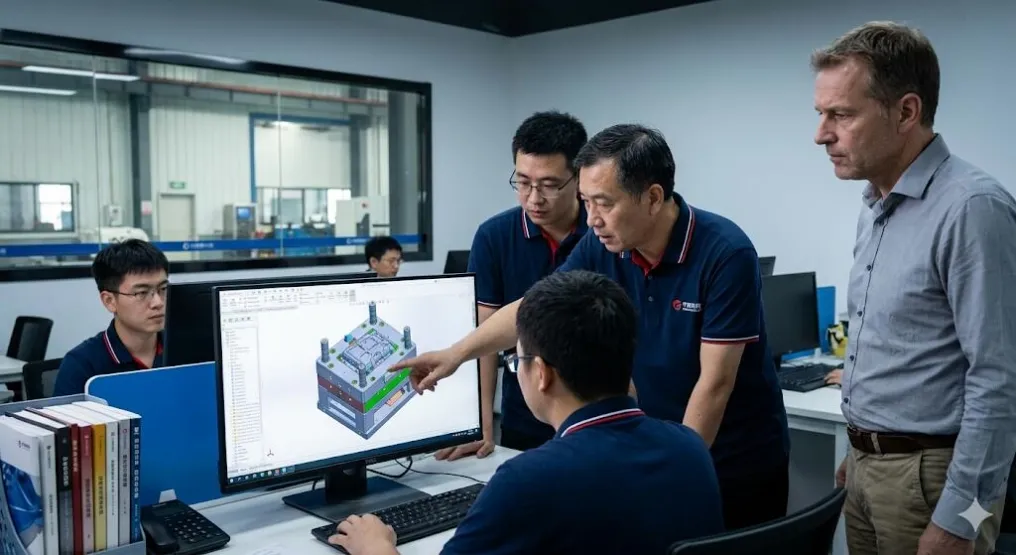
The Brain Center: Solving complex structural issues that stump ordinary tool shops.
- Start with Small-Order Testing to Evaluate Quality
If the preliminary assessment looks good, you can begin with small-amount cooperation—such as a prototype mold or a few custom-machined injection mold parts. Especially Rapid Prototyping is very popular. Capable and reliable plastic mold suppliers handle these professionally, and the risk for the customer is low and controllable. DFM review with Chinese mold maker can help you know your part's design out, and you can also know their manufacturing thoughts whether correct or not.
If the first cooperation goes well but you still have concerns, you can try a few more times. Once quality, service, delivery time, and price are consistently satisfactory, you can move to larger orders. Generally, this approach significantly reduces risk.
Final Engineering Audit Checklist
- The Power of the First "Touch" (Sales Outreach)
- Looking Beyond the Surface (Websites & Social Media)
- The "Technical Quiz"
- Social Proof with a Respectful Boundary
- The Digital "Face-to-Face" (Teams/Zoom)
- Seeing is Believing: The Factory Visit
- The "Workshop Spy" (Observe Other Molds)
- The "Live Exam" for the Design Team
9. Starting Small to Build Big(small order test with China mold maker)
Through the above 9 points, I believe they can provide useful reference value.
So, going back to the topic—how to find a reliable Chinese injection mold manufacturer for cooperation? Everyone may have different ideas now, because this is an open-ended question where opinions vary. Every customer and supplier has different focus points. When choosing a mold supplier, start from your own company’s actual situation. For example, one European customer told us he prefers mold manufacturers with fewer than 50 people, because from his years of sourcing experience in China, this size often offers good prices, fast delivery, a single point of contact, and high efficiency.
Stop gambling with your project’s success.
Finding a supplier in China is easy; finding an engineering partner who speaks your technical language is the hard part. I’ve seen too many "perfect" powerpoint presentations lead to "disastrous" T1 trials. If your current vendor avoids your technical quizzes or can't show you a raw CMM report, they are hiding their risks behind your budget.
At JST Mould, we welcome your toughest engineering questions. We don’t ask for your trust—we earn it through DFM transparency and verified data. Let’s start with a technical benchmark discussion today.