
Engineering Whitepapers
Prepare a Complete Plastic Parts RFQ
A practical RFQ checklist for custom molded plastic parts: define CAD, resin, CTQs, appearance, volume, inspection, packaging and quotation assumptions.
A quotation for custom injection-molded plastic parts is only as useful as its requirements. If suppliers assume different resin grades, cosmetic standards, inspection scopes or delivery arrangements, their unit prices are not directly comparable—even with the same 3D model.
A good RFQ defines the component, material, critical functions, acceptance criteria, order pattern and delivery responsibilities. It separates confirmed requirements from open decisions so suppliers do not silently make different assumptions.
Why Is a 3D CAD File Not a Complete Parts RFQ?
A 3D CAD model communicates nominal geometry, but may not identify functional dimensions, cosmetic zones, the approved resin grade, or inspection and packaging requirements.
- 3D CAD: preferably a neutral solid format such as STEP, with part number and revision.
- 2D drawing: when available, showing datums, critical dimensions, geometric tolerances, threads and inspection notes.
- Assembly context: mating parts or assembly CAD where fit, sealing or movement matters.
- Design status: released, quotation-only, prototype or still under revision. State which file controls if revisions differ.
- Application: the part's function, operating environment and relevant service conditions.
A 2D drawing is not mandatory for every preliminary discussion. If it is not ready, identify known CTQs and open dimensions rather than letting the supplier assume every CAD dimension has the same acceptance status.
Which Resin, Grade and Color Must Be Specified?
“ABS,” “PA” or “clear plastic” may be too broad for a production quotation. Grades within one resin family can differ in shrinkage, flow, stiffness, impact, moisture and temperature behavior. Reinforcement and additives can also affect processing and part performance.
Where defined, state the resin manufacturer, exact grade, reinforcement or additive package, approved source and customer-specific material requirements. If the grade is not selected, provide candidate materials and mark the final choice as open. Do not allow an unapproved grade substitution.
Color needs its own definition. Specify a color code or approved physical master, the required color location, gloss or texture, and whether matching is judged under agreed lighting. If a numerical color-difference limit is required, identify its method and acceptance limit. State whether regrind, recycled content, alternate resin sources or color masterbatch substitutions are permitted. These are project-specific requirements, not universal defaults.
Which Dimensions Are CTQ—and Which Are General?
Do not treat every dimension on a molded part as equally critical. Identify the dimensions that control assembly, sealing, alignment, movement, electrical fit, safety or another defined function. Mark them as critical-to-quality (CTQ), link them to datums and state how they should be measured.
General dimensions can follow an agreed drawing standard, while CTQs need individual limits and a clear measurement method. Specify conditioning state, measurement temperature or timing after molding when these affect the result.
Plastic parts should not automatically inherit metal-machining tolerances. ISO 20457:2026, Plastics moulded parts — Tolerances and acceptance conditions, provides a plastics-specific framework for dimensional and geometrical tolerances, acceptance conditions and technically achievable tolerances. It also excludes molded-part surface imperfections such as sink marks, unwanted flow structures, roughness and joint lines; these need separate appearance criteria. See ISO 20457:2026.
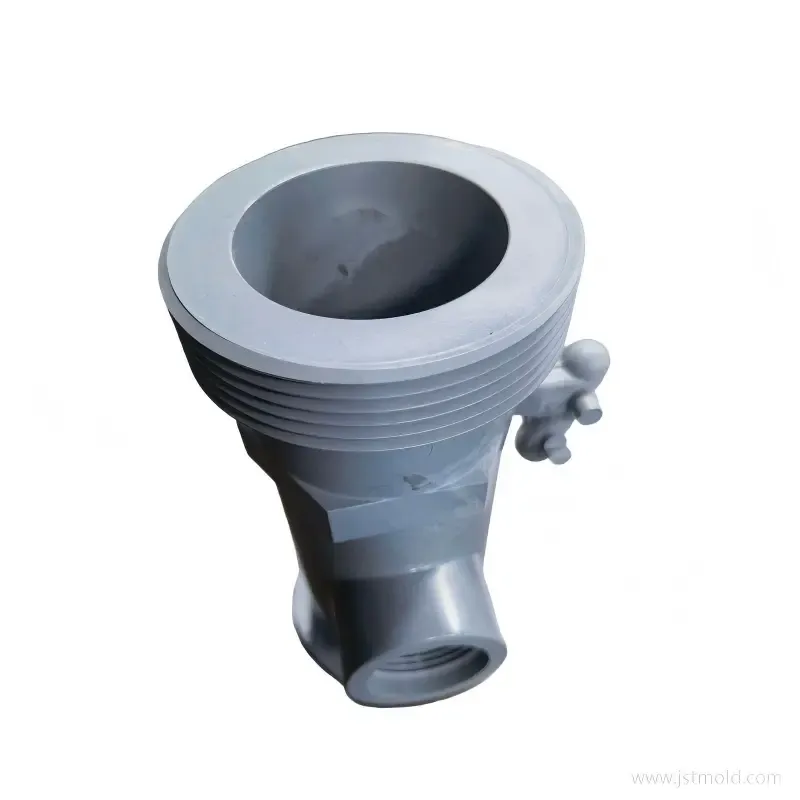
For example, a threaded fluid connector may need a defined thread profile, mating component, engagement length and sealing interface—not just an overall diameter. See JST's Custom Threaded Plastic Fluid Connector as a component reference. Its page illustrates why thread geometry, resin requirements and inspection should be reviewed against the actual application; it does not establish another customer's specification.
How Should Cosmetic Surfaces Be Accepted?
Terms such as “good appearance,” “high gloss” or “transparent” are open to interpretation unless the buyer defines what will be inspected and under what conditions. Mark cosmetic zones and identify the viewing side, inspection distance, lighting, and acceptable locations for gate marks, ejector marks, parting lines or witness marks.
Where relevant, define limits for scratches, sink, flow marks, flash, color variation, haze or contamination. Use an approved visual master or physical boundary samples when words are insufficient. If gloss is controlled, specify the measurement geometry and limit; ASTM D523-25 is a method for measuring specular gloss on nonmetallic materials, not a universal cosmetic acceptance standard.
For transparent components, do not assume a photograph proves optical-grade performance. JST's Transparent Thin-Wall Appliance Storage Tray is a visible product reference. Its page distinguishes visible transparency from an unverified resin grade, optical classification, haze limit or dimensional tolerance. Buyers should define those requirements separately when they matter.
Why Must Annual Demand and Order Quantity Be Separate?
Annual volume is forecast demand over a defined period. Order quantity is the number of parts released on an individual purchase order or shipment. They are not interchangeable.
State estimated annual demand and expected quantity per order or release. Add the forecast horizon, ramp-up assumptions, demand variability and whether the forecast is binding or indicative. If you need price breaks, ask suppliers to quote the same quantity tiers.
Do not assume an MOQ, safety stock, production lead time or capacity. Ask the supplier to state its minimum practical batch, lead time by quantity and any capacity assumptions that still need confirmation.
Who Owns the Mold—and Where Will Parts Be Produced?
State whether the buyer supplies an existing mold, purchases new tooling, or expects the supplier to arrange tooling. If new tooling is required, clarify ownership, storage location, access rights, maintenance, repair approval and the process for transferring the tool to another factory.
Identify the intended production location. The mold owner, tooling supplier and finished-part manufacturer may be different parties. The quotation should state who is responsible for mold maintenance, production scheduling, process control, inspection, packaging and shipment. If a supplier coordinates qualified manufacturing resources, confirm the actual production site and division of responsibility for that project rather than assuming them from a general capability statement.
What Inspection and Validation Records Should Be Requested?
Define inspection by risk and function, not by requesting every possible report on every order. Depending on the component, an RFQ may specify:
- First-article or initial-sample dimensional report for identified CTQs.
- Material certificate, certificate of conformity or lot documentation where required.
- Functional tests such as fit, torque, leak, pressure or load tests when relevant.
- Appearance criteria and approved visual samples.
- Sampling frequency, inspection level and record-retention period.
- Process validation or capability evidence when required by risk, customer standard or contract.
State the test method, sample quantity, conditioning requirements, acceptance limit and who approves deviations. A single sample or general quality statement does not prove that every future lot will meet the requirement. Where conditioning affects measurements, agree conditions and timing; ISO 291 provides standard atmospheres for conditioning and testing plastics, but project requirements still need to be stated.
How Should Packaging, Traceability and Delivery Be Defined?
Specify protection against scratches, deformation, contamination, moisture or electrostatic discharge where applicable. State pack quantity, whether parts may contact one another, label and lot data, barcode, carton limits, palletization and export packaging.
For traceability, identify the required batch code, material-lot linkage, production date and any cavity identification or records that must accompany shipment. For delivery, specify ship-to location, required dates, shipment frequency, split-shipment rules, Incoterms where applicable, freight responsibility and who approves schedule changes.
How Can Buyers Compare Plastic Parts Quotations Fairly?
Compare quotations only after aligning the technical and commercial basis. Ask each supplier to disclose assumptions, exclusions and open items.
Comparison area | What to align |
|---|---|
Part definition | CAD/drawing revision, included components and approved changes |
Material | Exact resin grade, source, color, additives and substitution policy |
Quality | CTQs, appearance limits, tests, sampling and records |
Tooling | Existing or new mold, ownership, maintenance and production location |
Volume | Annual forecast, order quantity, price tiers and MOQ assumptions |
Commercials | Unit price, tooling/setup charges, packaging, freight, taxes and payment terms |
Delivery | Lead-time basis, release schedule, Incoterms and shipment responsibilities |
A lower unit price may exclude inspection records, special packaging, material controls or tooling maintenance that another quotation includes. Ask suppliers to separate confirmed scope from optional items and unresolved assumptions. This is more useful than ranking headline prices alone.
Plastic Parts RFQ Checklist: What to Send First
Essential to identify the project: part number and revision; 3D CAD or available geometry; application; resin family or known grade; annual demand; expected order quantity; production location or sourcing model; and delivery destination.
Strongly recommended where applicable: controlled 2D drawing; CTQ dimensions and datums; color and cosmetic zones; assembly data; functional test requirements; approved material source; packaging specification; traceability requirements; and target price tiers.
May remain open for supplier evaluation: final resin grade, color-matching method, mold concept, cavity count, inspection sampling level, process-validation scope and detailed production arrangement—provided each open item is identified and the supplier states its assumptions.
Must be agreed in writing before order or production release: material substitutions, CTQ acceptance, cosmetic standards, tooling ownership and maintenance, production location, inspection and deviation approval, packaging, delivery terms and responsibility for engineering changes.
Frequently Asked Questions
Can I request a quotation with only a 3D CAD model?
You can start an initial review with a usable 3D model, but a comparable quotation may also require material, CTQs, appearance, volume, inspection and delivery requirements. Mark missing items as open.
Can a supplier substitute a resin grade or color masterbatch?
Only if the buyer's specification permits it and the substitution is reviewed and approved in writing. A change in grade, reinforcement, additives or color system can affect processing, dimensions, appearance and performance.
Should every dimension be marked as CTQ?
No. Identify dimensions that control function, fit, sealing, safety or another important requirement. Apply appropriate general tolerances to other features and agree how CTQs will be measured.
Why should I provide both annual volume and order quantity?
Annual demand helps suppliers understand expected business over time. Order quantity determines the size and frequency of individual releases. Both affect pricing, capacity planning, inventory and delivery assumptions.
Does the lowest unit-price quotation usually offer the best value?
Not necessarily. Compare the same material, quality, tooling, packaging, delivery and commercial scope. Ask suppliers to disclose exclusions and assumptions before selecting a quotation.
Request a Plastic Parts RFQ / DFM Review
Send the available 3D CAD, 2D drawing, resin grade or candidate material, color and appearance requirements, CTQ dimensions, annual demand, order quantity, inspection requirements, packaging and delivery details. Mark unfinished items as provisional so the quotation can identify its assumptions.
Start your project through the JST Contact page. The page asks customers to describe the project in the form and email STEP/IGES CAD files to info@jstmould.com. If an NDA is required, contact JST before sending confidential technical files.