
Jul 22, 2026Tier-1 Success Stories
Smart Dispenser Tooling: Preventing Field Failures via Optical Clarity & ESC Engineering Logic
Solve "ghost triggers" and stress cracking in smart dispensers. JST Mould optimizes IR window optical clarity (SPI A-1), chemical resistance (PC/PBT), and gear sync via conformal cooling and DFM.
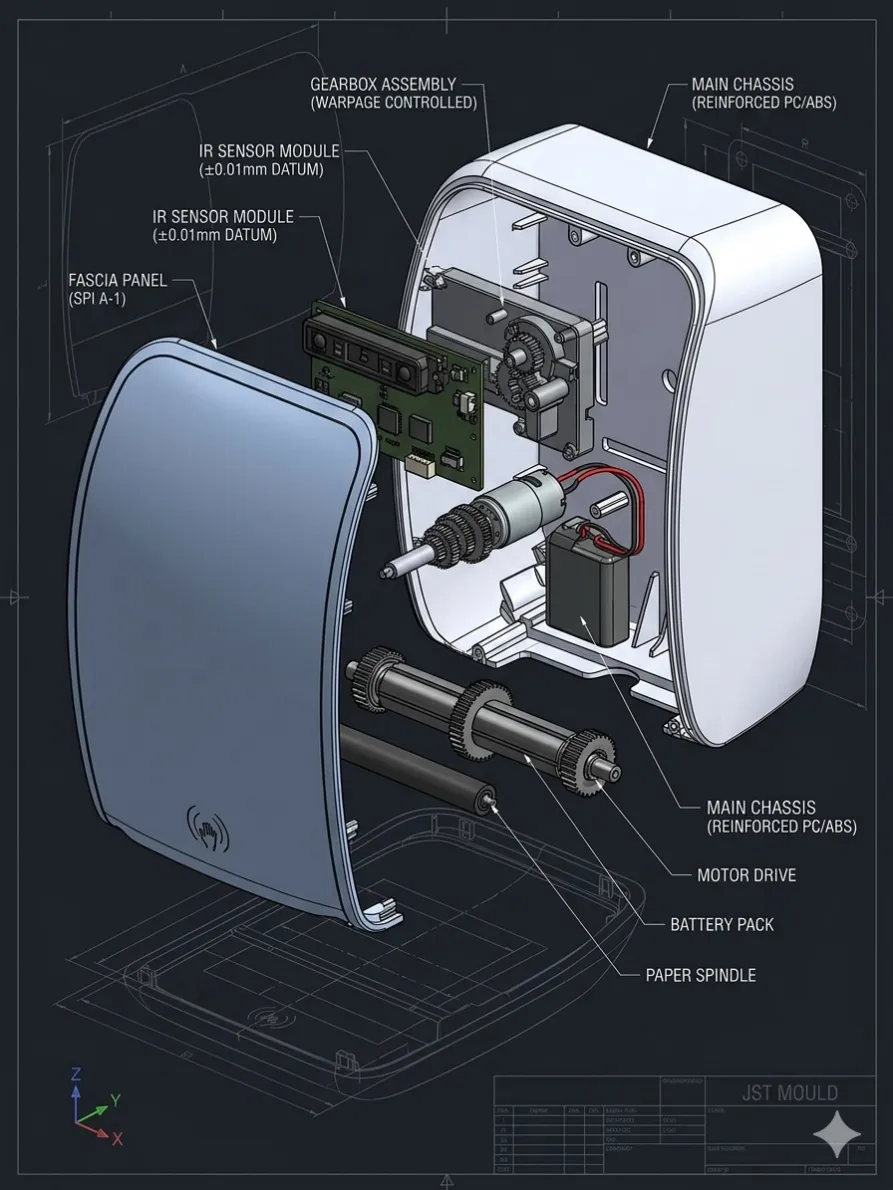
Primary Keywords: Smart Dispenser Tooling, IATF 16949 Injection Molding, Chemical Resistance Plastics, DFM for Hygiene Hardware, Optical Clarity IR Window.
Integrated Engineering: Managing complex interference fits and +/-0.01mm sensor mounting datums.
Introduction
Let’s be candid: a touchless dispenser is only as "smart" as the plastic housing that protects its electronics. In high-traffic environments like airports or hospitals, a 0.1mm deviation in a gear housing or a slight haze on an IR window isn't just a minor defect—it's a service call, a warranty claim, and a hit to your brand reputation.
At JST Mould, we’ve seen Tier-1 hygiene brands struggle when moving from low-volume prototypes to mass production. Drawing on our IATF 16949 automotive background, we treat smart dispensers as precision electromechanical systems. Here is how we apply "Zero-Defect" automotive logic to solve the 3 biggest pain points in smart hygiene hardware.
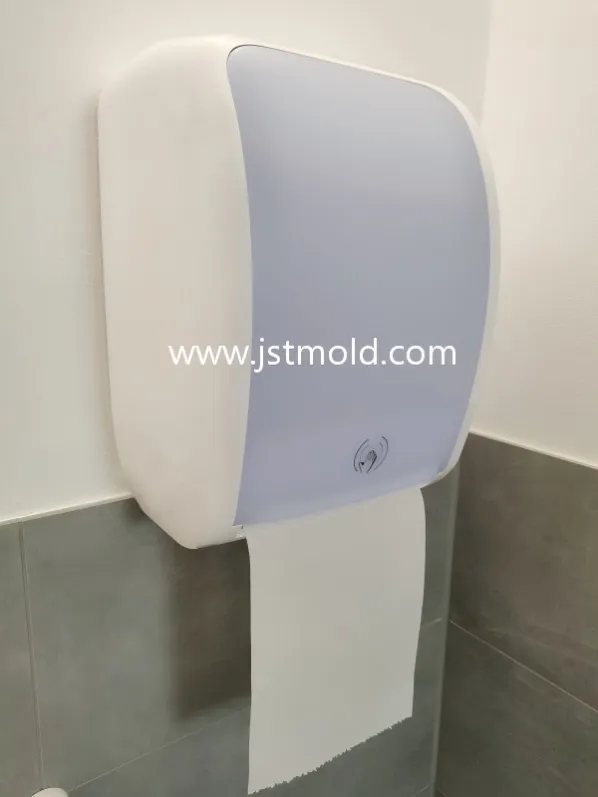
Optical Excellence: SPI A-1 mirror polishing ensures reliable IR sensor triggering.
- Eliminating "Ghost Triggers": The Physics of Optical Clarity
Most sensor malfunctions are misdiagnosed as PCB issues. In reality, they are often caused by Birefringence (internal stress) or Flow Marks on the transparent IR window.
- The JST Solution: We don't just use clear plastic. We employ SPI A-1 diamond-grade mirror polishing on specific inserts and optimize gate locations through Moldflow simulation to ensure the IR beam has a crystal-clear path. By holding sensor mounting datums to ±0.01mm, we eliminate the beam scattering that causes erratic triggering.
- Chemical Resistance: Solving Environmental Stress Cracking (ESC)
Public dispensers face a brutal cocktail of high-alcohol sanitizers and caustic cleaning agents. Standard ABS often fails within 6 months, developing micro-cracks that lead to fluid leakage and shorted circuits.
- Engineering Strategy: During the DFM phase, we consult on resin selection—often recommending specialized PC/PBT alloys or High-Impact PP tailored for chemical exposure. We focus on minimizing "molded-in stress" through precise thermal management, ensuring the housing remains ductile and crack-free for a 5+ year service life.
- Mechanical Synchronization: Countering Warpage in Large-Format Housings
A paper towel dispenser is a system of rollers and cutters. If the 300mm+ backplate warps by even 0.5mm, the gears won't mesh, leading to noise and jams.
- Technical Fix: We utilize Conformal Cooling and strategic ribbing architecture (derived from automotive door panel design) to ensure parts stay dead-flat. This ensures the internal mechanism runs silent and smooth—the hallmark of a premium product.
Sensor Soap Dispenser | IPX4 Precision Sealing
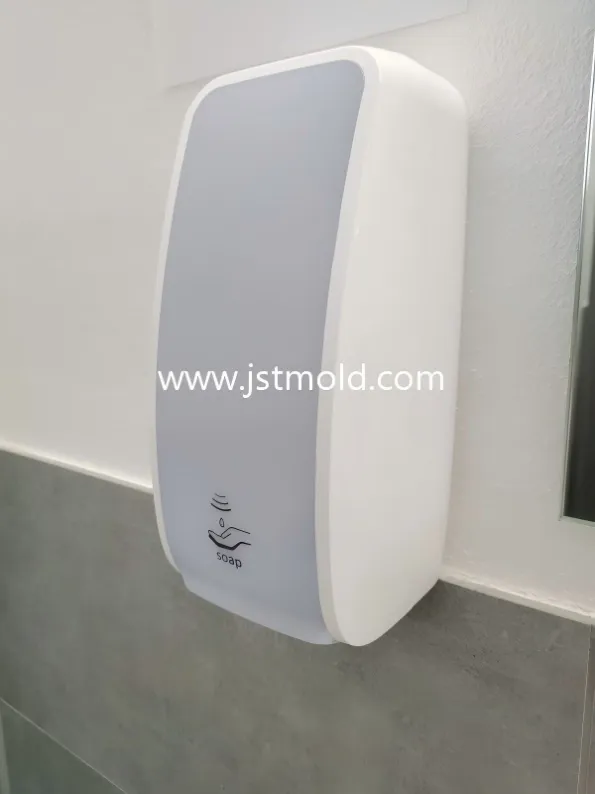
ESC Prevention: Proactive resin selection (PC/PBT or High-Impact PP) for sanitizer resistance.
The JST Edge: German Precision, China Speed
We bridge the gap between expensive European tool shops and unreliable low-end suppliers. We provide:
- 48-Hour DFM & Moldflow: Identifying sink marks and parting line issues before steel is cut.
- Micron-Level Tolerances: Essential for high-speed automated assembly lines.
- Scale: Multi-cavity tooling optimized for cycle-time efficiency.
Technical Value-Add
Beyond the Shell: Integrated Engineering & Fit Verification
We often see engineers overlook the 'Gate Residual' on the sensor window—a small mistake that leads to massive IR interference.
As a full-service engineering partner, our expertise extends far beyond molding the "plastic shell." We understand that a smart dispenser is a symphony of moving parts.
- Interference Fit & Tolerance Stack-up: We provide proactive verification of interference fits between plastic housings, motor mounts, and sensor brackets. This ensures that every snap-fit is secure and every mechanical interface is optimized for high-speed automated assembly.
- Electro-Mechanical Synchronization: We assist in validating the clearance for PCBs and routing paths for wiring, ensuring that heat dissipation and signal integrity are never compromised by the tooling design.
- End-to-End Reliability: By managing the critical tolerances between the "static" housing and "dynamic" internal components, we eliminate the risk of rattles, friction-wear, or component displacement during long-term field use.
Auto Paper Towel System | High-Stability Molding
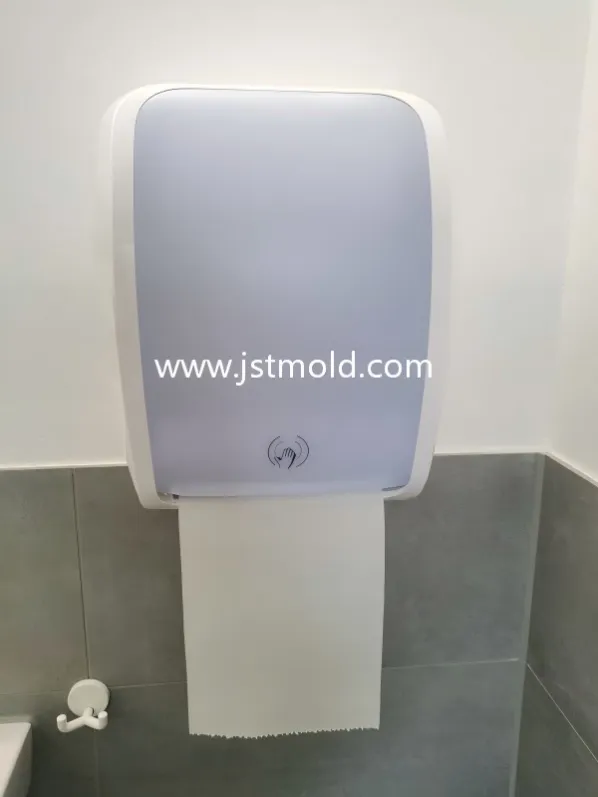
System Harmony: German technical rigor ensuring 100% end-to-end reliability in high-traffic environments.
At JST Mould, we don't just build molds; we ensure your entire system works in perfect harmony.
Ready to de-risk your next smart restroom project?
Is your "Smart" product failing because of "Dumb" tooling?
Let’s be candid: A touchless dispenser is only as reliable as the plastic housing protecting its electronics. If your IR window has birefringence or your gears jam because of 0.5mm warpage, it’s not a sensor issue—it’s a tooling failure.
At JST Mould, we treat smart hardware as precision electromechanical systems. We don’t just cut steel; we ensure your entire assembly works in perfect harmony. Don't risk your brand reputation on "good enough" molds. Let’s execute a technical DFM audit before your next production run.
REQUEST A TECHNICAL OPTICAL AUDIT
GET A MATERIAL COMPATIBILITY REVIEW