
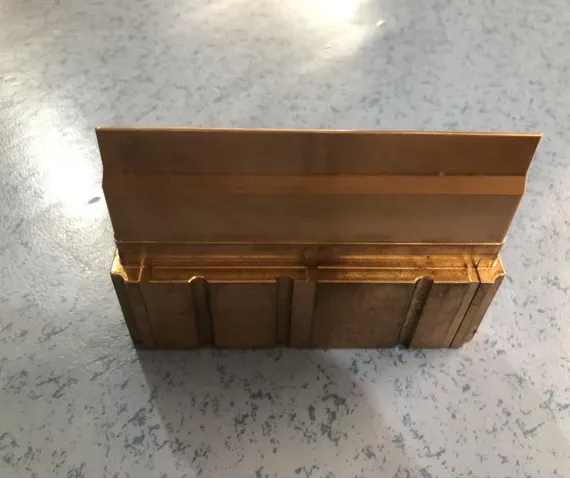
Mould components
Beryllium Copper Mold Inserts & Components
Custom beryllium copper mold inserts and components for localized heat-transfer applications in injection mold tooling. Share your drawing, material requirements and critical interface details for a project-specific review.
Beryllium copper mold inserts are considered for selected injection mold locations where localized heat transfer is an important design requirement. Their use should be evaluated as part of the complete mold system, including the insert geometry, surrounding tool steel, contact interfaces, operating conditions and inspection requirements.
JST Mould can review project information for custom mold components and discuss the drawing, material specification and functional requirements with your engineering or procurement team. Final material selection, manufacturing feasibility and acceptance criteria must be confirmed against the actual project documentation.
Where Beryllium Copper Mold Components May Be Considered
A high-conductivity copper-alloy insert may be considered when a defined region of a mold needs a different heat-transfer path from the surrounding steel structure.
Potential application considerations include:
- Localized hot areas around deep or narrow core features.
- Mold regions where conventional cooling passages cannot be positioned close to the molding surface.
- Selected core, cavity or insert features where the thermal path needs engineering review.
- Mold designs that use a localized copper-alloy component within a larger steel tooling structure.
The suitability of beryllium copper depends on the actual alloy and temper, mechanical requirements, wear conditions, geometry, operating temperature and the design of the surrounding mold. It is not a universal replacement for tool steel or a substitute for a properly designed cooling system.
Engineering Factors to Review
Material grade and condition
“Beryllium copper” alone is not a complete material specification. The required alloy designation, temper, product form and supporting material documentation should be confirmed before manufacture. Published material properties must be applied only to the specific grade and condition to which they refer.
Insert-to-steel interface
The insert must be evaluated in relation to its mold-steel pocket and supporting structure. Locating datums, retention, fit, contact surfaces, thermal expansion and serviceability may all affect the assembly. Clearance or interference should be established from the actual materials, geometry and operating conditions rather than assumed from a generic rule.
Machining and inspection requirements
The drawing should identify critical dimensions, datums, geometric tolerances, surface conditions and functional mating faces. The inspection plan should be agreed before quotation so that the required dimensional and material evidence is clear.
Occupational health and processing controls
Machining and finishing beryllium-containing materials can generate airborne particles. The applicable occupational exposure assessment, engineering controls, work practices, cleaning, maintenance and waste handling must be addressed by the processing facility in accordance with relevant local requirements. Buyers should verify the supplier's controls for the actual operations. No specific facility control or certification should be assumed without evidence.
Information to Include in Your RFQ
For a project-specific review, provide as much of the following as is available:
- 2D component drawing with dimensions and datum references.
- 3D CAD model.
- Required alloy grade and temper, or a request for material-selection discussion.
- Insert location and surrounding mold-steel information.
- Critical fit, locating and retention requirements.
- Functional surface-finish and wear requirements.
- Operating temperature and thermal conditions.
- Inspection requirements and acceptance criteria.
- Quantity and project timing.
If the material grade or temper has not yet been selected, identify it as an open engineering item rather than treating an assumption as an approved specification.
Related Engineering Guide
For a deeper discussion of thermal conductivity, precision machining, insert-to-steel interfaces, inspection and buyer evaluation, read:
Request a Project Review
If you are evaluating a beryllium copper mold insert or component, share your 2D drawing, 3D CAD model, material requirement and critical interface details with JST Mould.
Material selection, manufacturing feasibility, inspection scope and any beryllium-specific processing controls must be confirmed for the actual project before order acceptance.