
Aug 1, 2026Precision Engineering & Tooling
Global Tooling Standards: Mastering Material Synchronization and Dynamic Accuracy (2026 Edition)
2026 Mold manufacturing: From global resin synchronization to dynamic accuracy logic and ROI-driven maintenance for Tier-1 tooling programs.

Introduction
In the contemporary industrial landscape, mold manufacturing has transcended its traditional roots to become the backbone of high-precision mass production. As the "Mother of Industry," the quality of a mold determines the efficiency, cost, and lifecycle of the final product. At JST Mold, we integrate cutting-edge CAD/CAM/CAE systems with decades of artisanal expertise. This article provides an exhaustive analysis of the mold manufacturing ecosystem, designed for professionals seeking to understand the rigorous standards of modern tooling.
At JST Mould, our manufacturing process doesn't start at the machine; it starts with global material synchronization. As shown in the cover image, we routinely manage the arrival and customs clearance of overseas client-supplied resins to ensure our T1 trials represent 100% mass-production reality.
I. The Holistic Lifecycle of Mold Production
Global Collaboration: Arrival of customer-supplied resins, ready for 2026 Scientific Injection Molding (SIM) protocols.
At JST Mold, we view mold manufacturing not as a single event, but as a complex transformation of energy and information.
1. The Stages of Realization
The journey from raw material to a high-precision tool involves several critical milestones:
- Technical Preparation: The foundation stage involving DFM (Design for Manufacturing) analysis, material selection, and structural optimization.
- Production & Auxiliary Processes: Beyond core machining, this includes heat treatment, surface coating, and rigorous inspection protocols.
- Validation & Debugging: The "Proof of Concept" phase where the mold is trialed, and the process window is defined for the end-user.
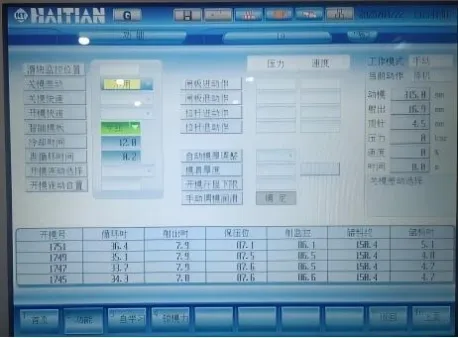
Digital Control: Defining validated process parameters for repeatable mass production.
2. The Core Workflow (Process Planning)
A mold’s quality is "built-in" during the planning phase. Our engineers focus on three pillars:
- Standardization: Developing process documents that guide every technician, ensuring consistency across shifts.
- Tooling Strategy (Secondary Tooling): A critical but often overlooked area. This involves designing specialized fixtures and auxiliary tools (Second-category tools) specifically for the machining of mold components, ensuring that complex geometries can be held and measured accurately.
- Adaptive Debugging: Post-assembly, the mold undergoes a systematic "Trial-Correct-Refine" cycle to eliminate flash, short shots, or dimensional instability.
II. Precision Engineering: Accuracy and Surface Integrity
Precision in mold making is multifaceted. At JST Mold, we categorize precision into two distinct domains:
1. Static vs. Dynamic Precision
- Static Precision: The dimensional accuracy, geometric tolerance (parallelism, perpendicularity), and surface roughness ($Ra$) of the mold in a controlled environment.
- Dynamic Precision (Kinematic Accuracy): The most critical factor for high-speed production. It refers to how the mold performs under thermal load and clamping pressure. We account for the "Dynamic Fit" to ensure that as temperatures rise, the alignment remains perfect.
JST Insight: We don't just measure steel at 25°C. We account for 'Kinematic Accuracy'—designing clearances and thermal compensation for core-pulling and sliders to remain perfect at operating temperatures of 140°C+.
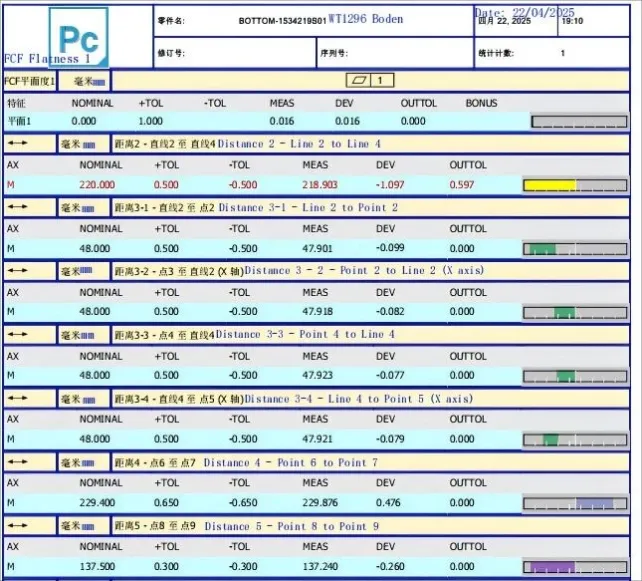
Verified Accuracy: Every micron is measured to ensure 100% alignment with 3D CAD data.
2. Factors Affecting Accuracy
We mitigate errors by focusing on:
- Material Stability: Selecting steels with high hardenability and low thermal distortion.
- Machining Sophistication: Moving beyond manual operations to high-automation CNC environments, which reduces human-induced variance.
III. Deep Dive: Classification and Machining of Mold Components
To provide a comprehensive view, we must look at the specific anatomy of a mold.
1. Classification by Surface Function
- External Surfaces: Often overlooked, these must be square and clean to facilitate accurate setup and clamping.
- Forming Surfaces (Cavity & Core): The "Business End" of the mold. These are categorized into:
- Planar Surfaces: Handled via precision milling or grinding.
- Revolving Surfaces: Machined via high-precision CNC turning.
- Complex Contours: Requiring 5-axis milling or EDM (Electrical Discharge Machining).
-
- Structural Surfaces: These include guide pin holes, ejector pin holes, and slider tracks. These require high positional accuracy to ensure the mold operates smoothly over millions of cycles.
2. Specialized Forming Methods
We employ three primary methods based on the material and complexity:
- Mechanical Removal: Traditional CNC milling and grinding for most steel components.
- Physical/Chemical Processing (EDM): Essential for hardened steels and intricate ribs where physical tools cannot reach.
- Specialized Forming: Utilizing techniques like cold-heading or specialized extrusion for specific insert geometries.
IV. The JST Maintenance Protocol: Maximizing ROI
A mold is a high-value asset. Without professional maintenance, even the best mold will fail prematurely. Our protocol includes:
- Atmospheric Control: Storing molds in dry, temperature-controlled environments to prevent oxidation.
- Lubrication Management: Systematic application of anti-rust agents to cavities and high-performance grease to moving slides.
- Integrity Checks: Regular "stress testing" of cooling lines to prevent scale buildup, ensuring consistent cycle times throughout the mold's life.
V. Future Trends: Digitalization and Standardization
The industry is shifting towards standardization (75% of parts in advanced markets are now off-the-shelf components) and Maintenance Protocol. At JST Mold, we are at the forefront of this transition, utilizing HSM to machine hardened steels ($HRC < 60$) with tolerances within $0.01mm$, significantly reducing the need for manual polishing and ensuring the highest level of surface integrity.
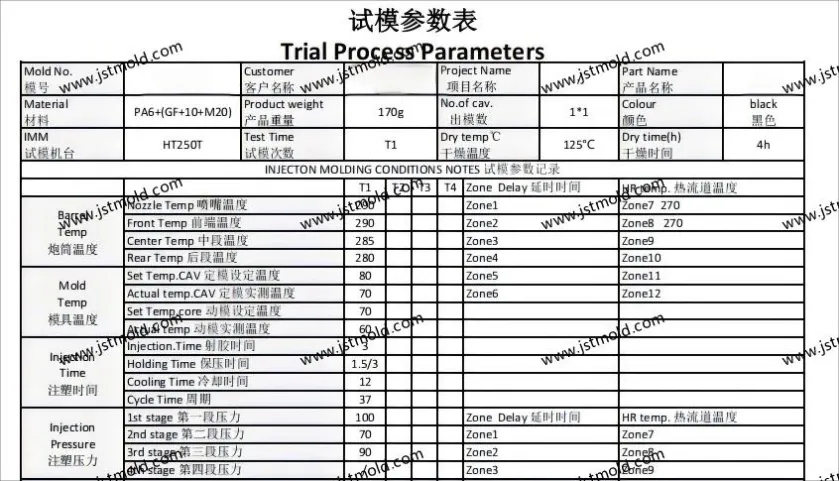
Technical Transparency: Comprehensive trial data ensures "Plug-and-Play" production setup.
Conclusion: Partnering for Precision
Mold manufacturing is where technical theory meets industrial reality. By choosing JST Mold, you are not just buying a tool; you are investing in a partnership dedicated to engineering excellence, operational longevity, and manufacturing success.
Striving for zero-defect production? Consult with our engineering team at JST Mold to discuss your next high-precision project. Whether it’s complex multi-cavity tools or high-tolerance technical parts, we provide the expertise to bring your vision to life.
Visit us: www.jstmould.com | Inquiry: info@jstmold.com
JST 2026 Expert Insight:
Listen, your project's success depends on the "Digital Twin" being identical to the physical tool. To safeguard your IP, please send your 3D files via corporate email to info@jstmould.com for a secure technical audit. We’ll show you how we manage 140°C+ dynamic accuracy before we ever touch the steel.