Aug 14, 2026Precision Engineering & Tooling
Engineering the 360° Internal Undercut: Achieving Zero-Defect Demolding in High-Performance Automotive Connectors
Struggling with 360° internal undercuts? Learn how we used collapsible core technology and Moldflow to achieve zero-defect production for automotive seal grooves.
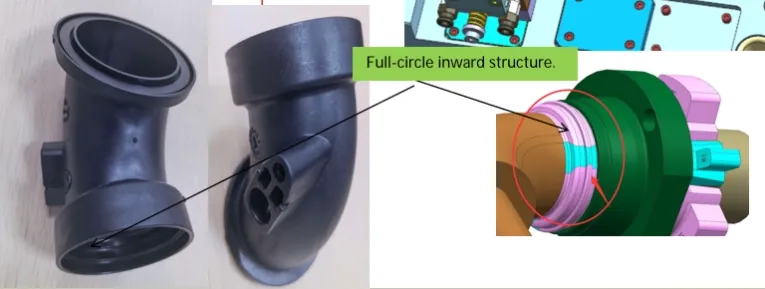
In precision injection molding, the 360-degree internal undercut (Continuous Internal Ring Groove) is often regarded as a "deal-breaker" for automated production. Traditionally, designers resorted to forced stripping or manual inserts—methods that inevitably lead to high scrap rates, stress whitening, and inconsistent sealing surfaces.
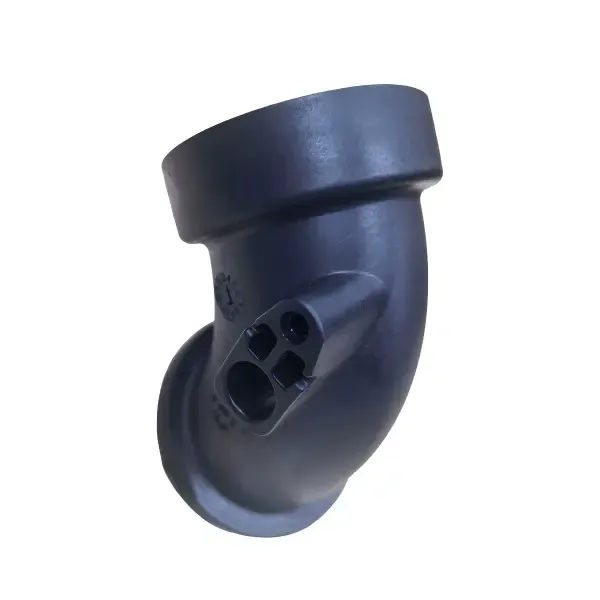
Side profile of the PA66-GF30 automotive elbow connector showing complex external geometry.
Recently, JST Mold handled a project for a complex [Automotive Air Vent Assembly] component that required a seamless internal groove for a high-pressure O-ring seal. Using a 30% glass-filled PA66, the challenge wasn't just creating the shape, but ensuring the part’s structural integrity during high-volume, 24/7 production.
1. The Material Selection & Geometry Conflict
When dealing with Injection Molding Material Selection, glass-filled resins (like PA66-GF30) offer superior structural strength but zero elasticity. Any attempt at "forced ejection" from a static core results in micro-cracks or "white stress marks" on the undercut wall. For a fluid-carrying [Plastic Pipe Connector], these micro-cracks are catastrophic, leading to slow leaks under pressure.
Our initial Moldflow analysis confirmed that the cooling shrinkage around the internal diameter would "lock" the part onto a standard core, making conventional side sliders impossible to use due to the 360° continuous nature of the feature.
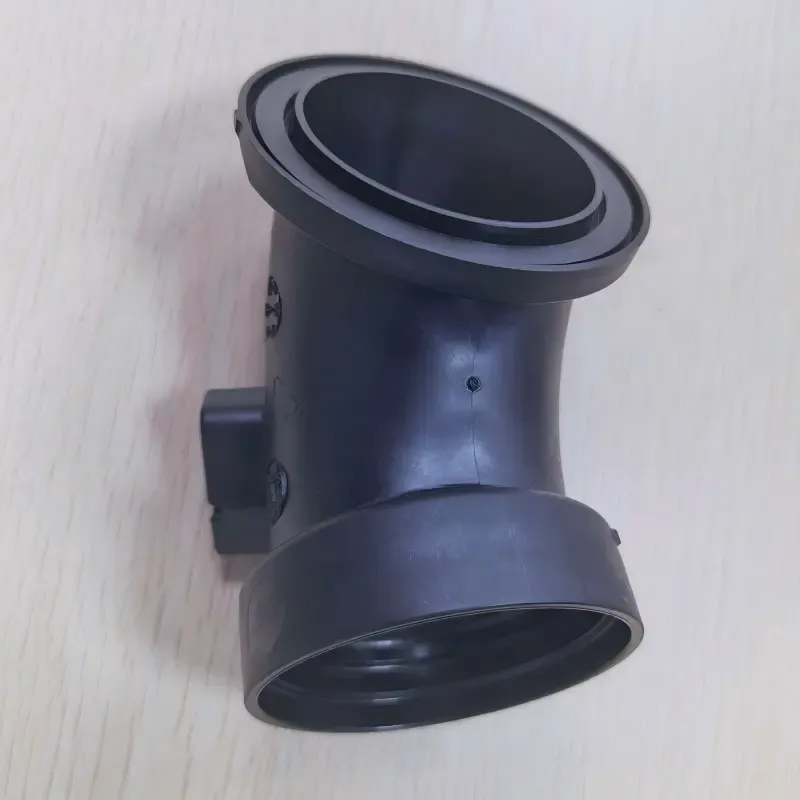
Macro view of the 360° internal ring groove that prevents traditional forced demolding.
2. The Solution: Dynamic Collapsible Core Kinematics
Instead of the high-risk forced stripping method, our engineering team developed a custom Collapsible Core (缩柯) system. This approach focuses on "Cores and Monolithic Molding"—creating a seamless internal geometry without the flash or mismatched parting lines associated with traditional split-core inserts.
- Mechanical Logic: The core is divided into segmented "petals." Upon mold opening, a center actuator retracts, allowing the segments to collapse toward the center axis. This creates the necessary clearance to clear the 360° internal ring groove before the ejection stroke begins.
- Precision Machining: To ensure these segments maintain a vacuum-tight fit over 500,000+ cycles, we utilized Beryllium Copper Machining for the center pin to maximize heat dissipation, paired with high-grade H13 ESR steel for the sliding segments.
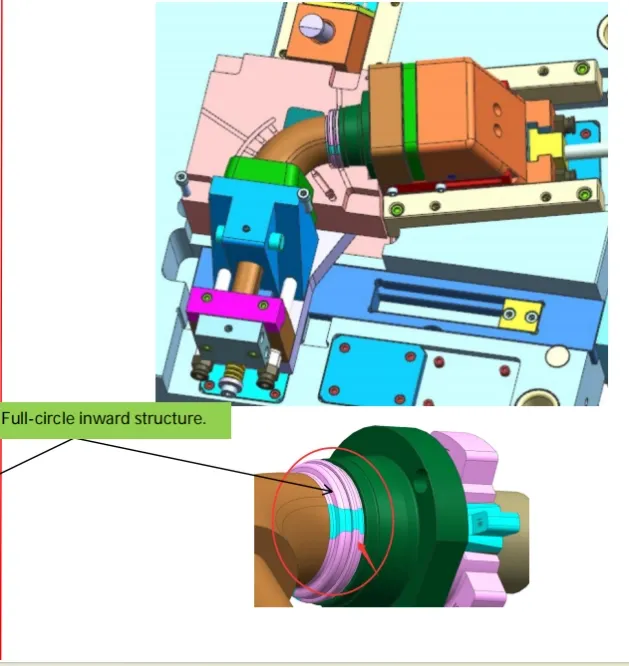
Engineering layout of the complex injection mold, showing the integration of multiple sliders and synchronized core segments.
3. Thermal Management and Steel Durability
One often-overlooked aspect of internal undercuts is "Heat Trapping." The center of a pipe connector is notoriously difficult to cool, which typically leads to ovality.
- Thermal Control: By integrating Beryllium Copper (BeCu) with targeted cooling channels, we maintained a stable core temperature. This prevents the "out-of-roundness" common in fluid connectors, ensuring the O-ring seat meets a strict roundness tolerance.
- Wear Resistance: For the mold base and supporting structures, we utilized Pre-hardened 3cr2nimo Steel, providing the necessary stability for high-pressure injection while ensuring the moving components operate with minimal friction and zero galling.
4. The Result: Stability Over Speed
While many manufacturers promise radical cycle time reductions, our focus for this Tier-1 project was Process Reliability. By replacing manual inserts with an automated collapsible core sequence:
- Yield Rate: Stabilized at 99.2%, eliminating the 35% scrap rate seen with previous forced-stripping attempts.
- Seal Integrity: 100% pass rate on helium pressure leak tests, thanks to the absence of internal parting lines.
- Maintenance: The DLC-coated segments allow for extended service intervals, significantly reducing the long-term "Total Cost of Ownership" for our client.
Seamless engineering: Bridging the gap between part design and advanced demolding kinematics.
Facing a Challenging Undercut on Your Next Project?
At JST Mold, we believe that the best DFM (Design for Manufacturing) isn't the one that promises the fastest cycle, but the one that ensures every part is as perfect as the first. Whether you are dealing with complex internal threads or 360° sealing grooves, we have the tooling expertise to make it manufacturable.
How we can support your project:
- Complimentary DFM Review: Send us your STEP/IGES files for a feasibility study on internal undercut solutions.
- Moldflow Validation: We provide detailed gate and cooling simulations to prevent quality issues before steel is cut.
- Expert Consulting: Speak directly with an engineer who understands the nuances of complex core kinematics and [Automotive Backlight Molding] requirements.
Ready to talk technical?
👉 [Upload your CAD for a 24-hour Technical Quote & DFM]