
Precision Engineering & Tooling
Diagnosing Plastic Snap-Fit Assembly Failures
Learn why plastic snap-fit latches break, whiten or fail to lock during assembly, and how engineers can identify the right design, material, molding or tooling improvements.
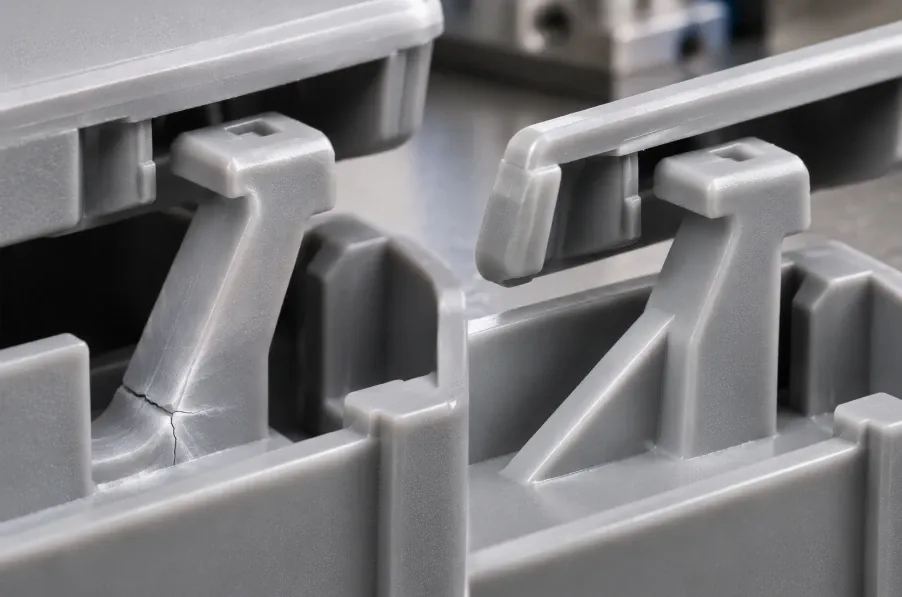
Plastic snap-fit latches can look normal after injection molding and still crack, turn white or fail to lock when the mating components are assembled. For product development engineers, automotive parts engineers and purchasing teams, the difficult question is not simply how to make the latch stronger. It is how to identify the actual cause before changing the product design, resin or injection mold.
JST Mould has encountered snap-fit assembly problems involving latch breakage, stress whitening and incomplete locking. A reinforcing rib can be one possible improvement, but it is not a universal solution. The appropriate correction depends on the component geometry, required deflection, assembly direction, material behavior and tooling conditions.
This article combines JST's confirmed practical experience with published industry failure analysis to explain how to approach these problems systematically. It is an engineering analysis, not a report of one named JST customer project.
1. Why Can a Snap-Fit Fail Even When the Molded Part Looks Normal?
A snap-fit works by allowing a flexible feature, or the surrounding component, to deflect as it passes the mating feature. Once engagement occurs, the feature recovers and provides retention.
Failure can happen at several stages:
- During assembly: The latch cracks, breaks or develops stress whitening.
- Immediately after engagement: The locking feature does not fully engage or the joint has insufficient retention.
- During repeated use: The latch gradually loses retention or develops fatigue-related damage.
A part that passes visual inspection before assembly is not necessarily mechanically suitable for assembly. The required deflection may exceed the available elastic deformation capacity. The mating parts may also have excessive interference, poor alignment or dimensional variation.
The first step is therefore to identify when the damage appears and how the latch behaves before and after engagement.
2. What Should Be Checked Before Changing the Design?
A useful investigation separates the problem into four areas.
Investigation area | What to review |
Product design | Effective latch length, thickness, root transition, engagement depth and available movement |
Material | Actual resin grade, material condition, stiffness, allowable deformation and possible contamination |
Injection molding | Filling, weld-line location, material degradation, shrinkage and warpage |
Mold design | Undercut release, draft, parting line, ejection support and local interference |
These factors can interact. A latch with limited flexibility may tolerate nominal assembly conditions but fail when dimensional variation increases the required deflection. A geometrically acceptable latch can also become brittle if the molded material has been compromised.
A published industry failure example
In a published Snap-Fit Failure investigation, The Madison Group examined an injection-molded ABS component whose retaining arm cracked during installation with its mating part. Failure was limited to approximately 1% of one production lot.
Microscopic examination identified an inclusion at the crack origin. SEM and EDS analysis found the inclusion to contain PPS contamination. Further testing found molecular degradation in the molded ABS, with a higher melt flow rate in failed parts than in the molding resin. The investigation concluded that contamination and processing-related degradation had combined to reduce material integrity and cause brittle fracture during snap-fit installation.
3. When Should Reinforcing Ribs Be Considered?
Adding a reinforcing rib can be useful when the surrounding structure does not provide sufficient support or when the load path needs to be redistributed.
Depending on the geometry, a rib may support a flexible wall or latch mounting region, improve local structural stability, or transfer loads into a larger supporting structure.
However, excessive reinforcement can create new problems. If a rib is placed too close to the flexible latch arm, it may restrict the movement required during assembly. A thicker root region may increase material accumulation, creating potential sink marks, voids or uneven cooling.
The correct approach is to evaluate the entire latch structure rather than simply add material around the damaged area.
Possible design adjustments include:
- Adding or repositioning a supporting rib.
- Modifying the root transition radius.
- Adjusting the effective flexible length.
- Revising latch thickness or taper.
- Changing engagement depth or lead-in geometry.
- Improving support for the surrounding wall.
Each option must be assessed against the actual required deflection and retention function.
A design reference from Covestro explains the trade-off between reducing root stress concentration with a radius and avoiding an excessively thick transition that may contribute to sink or void formation. See Covestro's plastics design guidance.
4. How Can Material and Molding Conditions Contribute to Failure?
The material designation alone does not establish whether a snap-fit will perform reliably. Materials within the same polymer family can have different mechanical behavior depending on grade, formulation and processing history.
Important factors include:
- Actual resin grade and approved material substitutions.
- Moisture condition, where relevant.
- Regrind use or possible material contamination.
- Processing temperature and residence time.
- Local weld-line position and filling behavior.
- Fiber orientation in reinforced materials.
- Shrinkage and warpage around the locking features.
A resin substitution may change stiffness, allowable deformation and shrinkage even if the CAD geometry remains unchanged.
Molding conditions also deserve attention when a latch breaks consistently at the same location or when failures are concentrated in particular production batches.
If material degradation or contamination is suspected, comparison of failed parts, acceptable reference parts and retained resin samples may be necessary. Laboratory techniques such as FTIR, SEM, EDS or melt-flow testing can help investigate specific material questions. These tests should be selected according to the suspected failure mechanism rather than requested automatically for every broken latch.
5. Could the Mold Release or Ejection System Be Causing Damage?
Snap-fit performance during assembly and snap-fit release from the mold are two different engineering problems.
A feature may function correctly after assembly but still experience excessive loading during demolding.
The mold review should examine:
- Whether the latch creates an undercut relative to the mold opening direction.
- Whether the feature can be released directly or requires a lifter or slider.
- Whether elastic stripping is suitable for the actual geometry and material.
- Whether draft and surface conditions create excessive drag.
- Whether ejector pins or other release components apply unwanted force to the latch.
- Whether the part is sufficiently supported during ejection.
If whitening or cracking is already present before assembly, the mold release and ejection sequence deserves particular attention.
If the part is undamaged after demolding but fails only when the mating components are joined, assembly interference, alignment and required deflection should receive greater attention.
The actual sequence must be established through sample inspection rather than assumed from the final appearance.
6. How Should Engineers Select the Correct Improvement?
A reliable correction should address the identified cause while preserving the required assembly and retention functions.
Observed problem | Possible engineering response |
Cracking at the latch root | Review root radius, local strain and material condition |
Whitening during assembly | Review interference, deflection, alignment and root geometry |
Excessive assembly force | Review lead-in geometry, engagement depth and dimensional stack-up |
Incomplete locking | Review engagement position, mating dimensions and warpage |
Poor retention | Review hook geometry, engagement depth and supporting structure |
Damage before assembly | Review mold release, ejection and processing conditions |
These are investigation directions, not automatic corrective actions.
For example, adding a rib may improve support in one design but restrict the necessary latch movement in another. Increasing root thickness may improve structural support but also increase assembly force and create a thick molding section.
A material change may be appropriate when the existing resin cannot satisfy the required deformation and service conditions. However, material substitution should be evaluated together with revised geometry, molding process and tooling assumptions.
Where practical, compare alternative design concepts before committing to mold steel modifications.
7. What Should Be Reviewed During DFM?
The best opportunity to prevent snap-fit problems is before mold manufacturing begins.
A useful DFM review should connect the product geometry, mating component and actual mold release sequence.
JST recommends establishing the following information before approving the tooling design:
- The latest 3D CAD files for both mating components.
- The specified resin grade and any permitted alternatives.
- Assembly direction and required installation sequence.
- Target insertion force and retention requirements, where defined.
- Critical latch dimensions, engagement depth and tolerance requirements.
- Required opening, closing or repeated-use conditions.
- The intended mold opening and undercut release directions.
- Gate, cooling, parting-line and ejection considerations around the latch.
- Appearance requirements and permitted product modifications.
- Functional inspection and validation criteria.
The First Aid & Pharmacy Case Injection Mold | Medical Storage Box Tooling is a relevant JST tooling reference because its published design scope includes snap-fit locking features, ribbing, alignment, mold ejection and DFM review.
JST's engineering approach is to evaluate the actual product structure before recommending reinforcement, geometry changes or tooling modifications. The objective is to find a practical solution that supports assembly performance without creating unnecessary molding or manufacturing problems.
8. What Information Should You Send for an Engineering Review?
If your plastic snap-fit components are breaking, whitening or failing to lock, the following information can help establish the next investigation steps:
- 3D CAD files of both mating components.
- Current material grade and material data sheet.
- Photos of the latch before and after assembly.
- The exact location where cracking or whitening occurs.
- Assembly direction and available assembly equipment.
- Critical dimensions and tolerance requirements.
- Any existing insertion or retention test results.
- Information about the mold, ejection concept and molding process, if available.
If the failure occurs only in certain batches, provide information about the affected production lots and any known material or process changes.
This helps distinguish a structural design issue from a material, molding, dimensional or tooling-related problem before a corrective action is selected.
Frequently Asked Questions
Can adding a reinforcing rib prevent snap-fit latch breakage?
It can help when insufficient structural support is part of the problem. However, a rib may also restrict the required flexibility or create a thick molding section. Its position and geometry should be evaluated against the complete component structure.
Should we change the plastic material when a snap-fit breaks?
Not immediately. First establish whether the failure is related to excessive deflection, material condition, contamination, processing or another factor. A material change should be supported by the required mechanical and application conditions.
Why does a latch turn white without completely breaking?
Stress whitening can indicate localized deformation or damage, but it is not a definitive diagnosis. The location, timing and extent of whitening should be compared before and after assembly.
Can a mold manufacturer correct an existing snap-fit design?
A mold manufacturer can review tooling feasibility, release conditions and potential product-design improvements. The appropriate correction depends on the customer's design authority, available tooling modification options and the identified failure mechanism.
What information is needed for a snap-fit DFM review?
Provide both mating-part CAD files, the resin grade, critical dimensions, assembly direction, required retention performance and available failure photographs. Existing mold and production information is also useful when investigating an existing problem.
Request a Snap-Fit Engineering and DFM Review
If your plastic latch is breaking during assembly, developing stress whitening or failing to lock reliably, JST Mould can review the component geometry and related injection mold requirements.
Send your 3D CAD files, material information, mating-part dimensions and photographs of the failure. Our engineering team can assess potential structural, tooling and manufacturing risks and discuss suitable improvement options.