
Sep 23, 2026Engineering Whitepapers
Injection Mold Parting Surface Design: Principles, Shut-Offs and Complex Geometry
Learn how to design injection mold parting surfaces for clean shut-offs, stable machining, slider coordination, ejection and flash control in complex tooling.
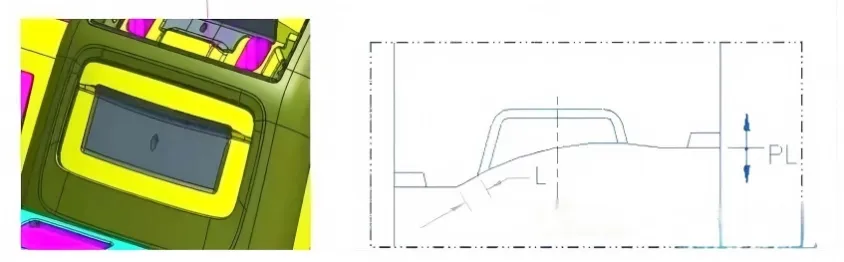
A parting surface is not simply the place where the two mold halves separate. Its position and geometry influence cosmetic appearance, shut-off reliability, flash risk, slider layout, ejection, machining difficulty, mold fitting and long-term maintenance.
For simple parts, the parting surface may be almost flat and obvious. For automotive housings, technical enclosures, deep ribs, side holes or complex undercuts, the decision becomes part of the overall mold architecture.
A practical parting-surface review should therefore answer three questions before steel is cut:
- Can the part be released safely in the planned mold-opening direction?
- Can the core, cavity and side-action components close and seal repeatedly without fragile steel conditions?
- Can the geometry be machined, fitted, vented and maintained without creating unnecessary tooling risk?
This guide focuses on those engineering decisions rather than treating the parting line as an isolated CAD feature.
1. Parting Line vs. Parting Surface: What Is the Difference?
The terms are closely related but not identical.
The parting line is the visible boundary on the molded part where two mold-forming components meet. The parting surface is the three-dimensional contact or separation surface between the mold components that creates that boundary.
On a simple box-shaped component, the line and surface may be straightforward. On a curved housing, stepped feature or side-action mold, the parting surface may extend, incline, wrap around geometry or interact with sliders and shut-offs.
This distinction matters because a visually acceptable parting line can still be supported by a poor parting surface. If the steel behind that line is too thin, difficult to machine, poorly supported or difficult to spot, the mold may develop flash, mismatch or wear even though the CAD split initially looks correct.
2. What Must Be Reviewed Before Choosing the Parting Surface?
Before selecting the final parting surface, the mold designer should review the complete release and manufacturing logic.
Product appearance and critical dimensions
Parting lines should be kept away from Class-A or highly visible surfaces whenever the product geometry allows it. Critical sealing faces, assembly interfaces and tight-tolerance features also require special attention because even a small mismatch between core and cavity can affect function.
Mold-opening direction and draft
The planned opening direction must allow the main core and cavity to separate without trapping the part. Draft, deep ribs, bosses and texture all influence the real release condition.
A geometrically possible split is not automatically a production-ready split if the part remains difficult to release after shrinkage.
Undercuts and side actions
External or internal undercuts may require sliders, lifters, split cores or other release mechanisms. The parting surface should be selected together with these mechanisms, not before them.
When side-action components form part of the product surface, their shut-offs and locking surfaces become part of the overall parting strategy.
Gate, venting and filling behavior
Gate position and flow direction can influence the pressure acting near the parting surface. Venting is also frequently placed at or near the final filling zone, which may coincide with the parting line.
The parting surface therefore has to provide enough sealing contact while still allowing appropriate venting where required.
Machining and mold fitting
A surface that is theoretically elegant but difficult to mill, grind, EDM or spot can increase tooling time and maintenance risk.
Whenever possible, the parting geometry should provide stable machining references, continuous surfaces and accessible fitting areas.
3. Seven Core Principles for Injection Mold Parting Surface Design
Principle 1: Protect cosmetic and functional surfaces
Locate the parting line where any witness line or minor mismatch has the least effect on appearance and function.
For cosmetic parts, the visible surface may justify moving the split toward a less visible edge even if the mold structure becomes slightly more complex. For technical parts, sealing faces, bearing areas, clip interfaces or precision assembly features may take priority over appearance.
The decision should follow the product requirement, not a universal rule.
Principle 2: Make safe demolding the first structural constraint
The selected surface must support the intended opening direction and allow the molded part to remain on the correct mold side for controlled ejection.
A common mistake is to choose the cleanest-looking split first and solve release problems later. That often creates unnecessary lifters, sliders or manual inserts.
Parting-surface selection should therefore be reviewed together with draft, shrinkage and the intended ejection side.
Principle 3: Coordinate the parting surface with sliders and undercuts
When a part contains side holes, hooks, grooves or external undercuts, the parting surface should simplify side-action travel wherever possible.
The shut-off between a slider and the surrounding cavity steel must provide:
- sufficient steel contact;
- stable locking and repeatability;
- enough draft or clearance to prevent galling;
- adequate support against injection pressure;
- practical access for machining and spotting.
For complex side-core pulling, the parting surface, slider travel and ejection sequence should be reviewed as one mechanism rather than as independent features.
For geometries that cannot be released with a conventional single slider, see our guide to half-slider mold design for complex undercuts.
Principle 4: Provide reliable shut-off surfaces
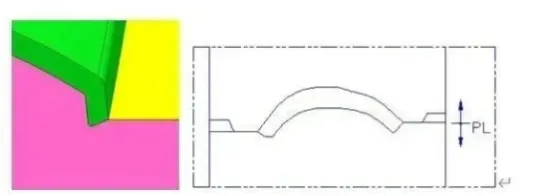
Reliable shut-offs require adequate steel support, repeatable positioning and practical release geometry.
Shut-offs must seal the cavity during injection while surviving repeated opening and closing cycles.
Very short, steep or unsupported shut-offs can be difficult to fit and may wear rapidly. Deep wipe-off surfaces with insufficient release angle can generate friction, galling and flash.
Where dimensional standards such as sealing-land width, relief depth or wipe-off angle are required, these should be defined according to mold size, product geometry, resin, injection pressure and expected tool life rather than copied blindly from a generic rule.
For detailed sealing-land, relief and wipe-off references, review our parting line sealing and shut-off design standards.
Principle 5: Avoid fragile “sharp steel” conditions
A parting line that follows the product geometry too literally may create thin steel, knife edges or narrow projections in the core or cavity.
These areas can chip during machining, mold fitting or production. They are also difficult to repair without affecting the molded surface.
A better solution may be to adjust the local split, add a replaceable insert, widen the steel support or transition into a more robust surface.
The objective is not to make the CAD split as close to the product outline as possible. The objective is to create a repeatable molding interface with enough steel behind it.
Principle 6: Make the parting surface machinable and spot-friendly
Parting surfaces should be designed with the real machining process in mind.
A manufacturable parting surface should prioritize smooth, continuous geometry and practical tool access.
For inclined surfaces, it is often useful to extend the surface into a stable reference or landing area instead of ending the slope abruptly.
For curved surfaces, continuity is important. Broken, wrinkled or self-intersecting patches can make CNC programming and mold fitting unnecessarily difficult.
Avoid treating one CAD command as universally “good” or “bad.” Extrude, offset, ruled, sweep and surface-extension tools can all be valid depending on the geometry. What matters is the final surface quality:
- continuous boundaries;
- controlled tangency where required;
- no self-intersections;
- no unnecessary micro-patches;
- sufficient machining access;
- stable steel support.
Principle 7: Review parting, venting and ejection as one system
Parting-surface design ends only when the molded part can be filled, sealed, opened and ejected repeatedly.
A surface that seals well but forces poor ejector placement can still create deformation or sticking. A surface that simplifies ejection but leaves weak shut-offs may create flash.
The final design should therefore be checked together with:
- gate and runner layout;
- expected final filling zones;
- vent locations;
- core/cavity retention;
- ejector pin or sleeve locations;
- slider return and locking;
- robot or manual part-removal direction.
For the release stage, our injection molding ejection system design guide explains how pin layout, support and release force should be coordinated with the mold structure.
4. Parting Surface Strategies for Common Geometries
Flat parting surfaces
A flat parting surface is normally the simplest option when the product geometry permits it.
Advantages include easier machining, fitting and pressure distribution. However, it should not be selected only because it is easy to manufacture. The resulting parting line must still satisfy appearance, draft, ejection and undercut requirements.
Inclined parting surfaces
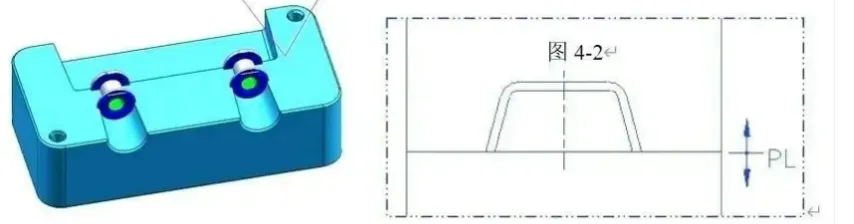
Extending an inclined parting surface into a stable landing area can simplify machining and mold spotting.
Inclined surfaces are common when product edges or contours do not lie on one plane.
Instead of ending an inclined surface abruptly, the designer can extend it into a stable transition or flat landing area. This provides a clearer machining reference and can improve mold spotting and support.
The transition should avoid thin steel at the ends of the incline.
Curved parting surfaces
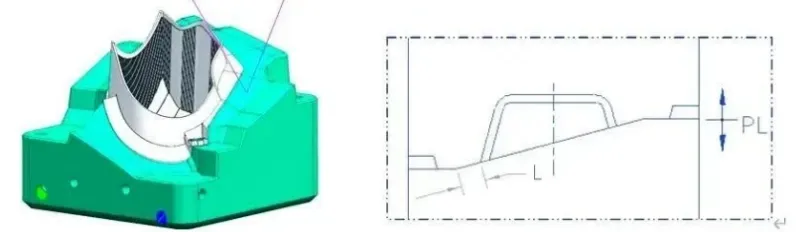
Continuous curved surfaces help maintain machining quality and repeatable core-cavity seating.
A single smooth curved parting surface can follow product geometry while keeping the mold split continuous.
The key is to maintain surface continuity and avoid unnecessary changes in curvature. The extended area outside the product should remain easy to machine and provide stable contact between the mold halves.
Stepped or multi-level parting surfaces
Stepped parting surfaces may be necessary around deep geometry, side features or different product heights.
They require more attention because each vertical transition can become a wipe-off or shut-off condition.
The designer should minimize unnecessary step changes, add practical release angles and make sure the structure can be spotted and maintained.
Composite and complex curved surfaces
For highly contoured parts, several surfaces may need to be connected into one parting system.
The goal is to simplify the final machining path as much as the product geometry allows. Smooth transitions and robust steel conditions are usually more valuable than reproducing every local product contour in the mold split.
5. Parting Surface and Undercut Strategy
Undercuts are one of the main reasons a seemingly simple parting surface becomes a complex mold-design problem.
The designer should first determine whether the feature can be released by changing the main parting position or product orientation. If not, an additional mechanism may be required.
Typical options include:
- conventional side slider;
- angled lifter;
- split slider or half slider;
- collapsible core;
- removable or replaceable insert;
- special unscrewing or rotating mechanism for threaded features.
The parting surface should help these mechanisms move in the shortest, most stable direction possible while preserving enough shut-off contact.
For a 360-degree internal groove, for example, moving the external parting line alone will not solve the release problem. A collapsible or segmented core may be a more appropriate solution depending on the resin, groove depth, tolerance and production volume.
6. How Parting Surface Design Affects Ejection
The part should normally remain on the mold side where ejection can be controlled.
Parting-surface selection influences which surfaces grip the core after shrinkage, where ejectors can be placed and whether ejection force can be distributed without damaging cosmetic or thin-wall areas.
Before approving the split, check:
- Which side is expected to retain the part after mold opening?
- Is there enough strong product area for ejector pins, sleeves or blades?
- Will any slider or lifter still interfere when ejection starts?
- Could the chosen split create excessive core grip or vacuum?
- Are visible ejector marks acceptable at the available locations?
If these questions cannot be answered clearly, the parting surface and ejection system should be reviewed together before mold design is released.
7. Common Parting Surface Problems and Their Likely Causes
8. DFM Checklist Before Releasing the Parting Surface for Tooling
Before mold steel is ordered or core/cavity machining begins, the DFM review should confirm:
□ Product orientation and main mold-opening direction are defined.
□ Draft has been checked on all main release surfaces.
□ Cosmetic and function-critical areas are identified.
□ All undercuts are mapped to a release mechanism.
□ Slider/lifter travel does not conflict with the main split or ejection.
□ Shut-off surfaces have adequate steel support and practical release angles.
□ Thin or fragile steel conditions have been removed or converted into replaceable inserts.
□ Curved and stepped surfaces can be machined and spotted without unnecessary EDM or hand fitting.
□ Gate location and expected filling direction have been reviewed relative to the parting line.
□ Venting can be placed at suitable final filling zones.
□ The part is expected to remain on the correct side for controlled ejection.
□ Ejector locations are available on structurally suitable product areas.
□ The split can be maintained and repaired during the expected production life.
□ Customer mold standards, machine interface and tool-life requirements have been considered.
This checklist should be completed before the parting surface is treated as “finished” in CAD.
9. Does Moldflow Determine the Best Parting Surface?
Not by itself.
Moldflow can help evaluate filling pattern, pressure, weld lines, air traps, temperature distribution and some deformation risks. Those results can influence gate position, venting strategy and local mold decisions near the parting surface.
However, the final parting surface is primarily a mechanical and manufacturing decision involving demolding, undercuts, shut-offs, steel strength, machining, fitting and ejection.
For simple parts, a good parting-surface decision may not require flow simulation at all. For complex, high-pressure or appearance-critical parts, Moldflow can provide additional evidence for the overall DFM review.
10. What Information Should Be Reviewed Before Quoting a Complex Mold?
For a useful tooling review, the mold supplier should receive more than a product image.
The most helpful RFQ information includes:
- 3D STEP or native CAD data;
- 2D drawings with critical tolerances, if available;
- resin grade and filler content;
- surface texture or cosmetic requirements;
- expected annual volume and target mold life;
- preferred gate or appearance restrictions, if already defined;
- injection machine specifications, when the mold must match an existing machine;
- required mold standard or customer-specific tooling specification.
With this information, the mold designer can evaluate the parting strategy together with sliders, lifters, ejection, gating, venting and machining before the final quotation and DFM are released.
Frequently Asked Questions About Injection Mold Parting Surfaces
What is the main purpose of an injection mold parting surface?
The parting surface allows the mold-forming components to separate while maintaining a sealed cavity during injection. Its design also affects appearance, flash control, demolding, side actions, machining and ejection.
Where should the parting line be placed on a cosmetic plastic part?
Where possible, it should be moved away from highly visible or function-critical surfaces. The final location must still provide safe demolding, adequate steel support and a practical mold structure.
Why does flash often appear along the parting line?
Possible causes include insufficient mold fit, worn or weak shut-offs, damaged steel edges, poor alignment, inadequate clamp force or excessive local cavity pressure. The mold and molding process should be checked together rather than assuming every flash problem is caused by one factor.
Can a complex parting surface eliminate the need for sliders?
Sometimes changing the product orientation or parting position can remove a minor undercut. However, true side features or deep undercuts may still require sliders, lifters, split cores or other mechanisms.
Should the parting surface always follow the product contour exactly?
No. Following the contour too closely may create thin steel, difficult machining or unstable shut-offs. The surface should balance product requirements with steel strength, manufacturability, fitting and long-term maintenance.
Should every complex parting surface be checked with Moldflow?
No. Moldflow is valuable for flow-related questions such as filling, pressure, weld lines and air traps, but it does not replace mechanical mold-design judgment. Its use should depend on the actual project risk and validation requirements.
Request a DFM Review for Complex Parting and Undercut Geometry
A reliable mold split should be decided before steel cutting, not corrected after repeated T1 trials.
If your plastic part includes curved parting lines, deep shut-offs, side holes, sliders, lifters or difficult ejection, send JST Mould your 3D STEP data together with the resin, expected production volume and key cosmetic or tolerance requirements.
Our engineering review can evaluate the parting surface together with side-action, ejection, gating, venting and manufacturability so that the tooling concept is clear before mold manufacturing begins.