
Oct 25, 2026Tier-1 Success Stories
Cutting Cycle Time by 48% on HDPE Precision Parts | JST Mould Case Study
See how JST Mould cut HDPE cycle time from 45s to 23.5s via Scientific Molding (DOE). We utilized sub-zero thermal balancing to eliminate ovality and double Tier-1 production capacity.
Target Keywords: Cycle Time Reduction, HDPE Injection Molding, Scientific Molding DOE, Warpage Solution
Killing 22 Seconds: The Physics of High-Speed HDPE Production
In high-volume Tier-1 injection molding, cycle time isn’t just a parameter—it’s the thin line between a profitable contract and a logistical nightmare.
Recently, a European client challenged JST Mould with a precision HDPE component (20g). The baseline benchmark was 45 seconds. Their target? Under 25 seconds.
The high-stakes constraint: We only had 15kg of original overseas resin and a thin-walled circular geometry that refused to stay round under aggressive cooling.
Here is how our Lead Engineer, Thomas, utilized Scientific Injection Molding (SIM) and thermal logic to shave off 22 seconds without sacrificing a single micron of roundness.
1. The 15kg Resin Gamble: Strategic Resource Management
When a client flies in with only 15kg of proprietary resin, you don’t have the luxury of "guessing" the process. 15kg gives you only a handful of test shots. One wrong move and the material is gone before you even find the gate freeze time.
Thomas’s Directive: "Do not touch the client’s material first."
We executed a two-phase trial. First, we performed a Rheology & Viscosity Match using a local HDPE grade with an equivalent Melt Flow Index (MFI). We stabilized the press and established the baseline viscosity curve. Only when the process was optimized did we switch to the precious original resin.

Transparency & DOE Validation: Coordinating with the client to ship a full range of samples (45s, 60s, and 70s cycles) for physical benchmarking and process verification.
2. The "Grey Part" Crisis: Cleanliness as a Metric
During the initial T1 setup, the samples showed a subtle greyish tint. At JST, we don't ignore "minor" contamination.
The Diagnosis: Residual carbon from the machine’s barrel interface.
The Action: Thomas halted the trial for a deep-system purge. After a thorough manual cleaning of the nozzle interface, the second batch emerged pristine white. The client’s response? "These look much better."
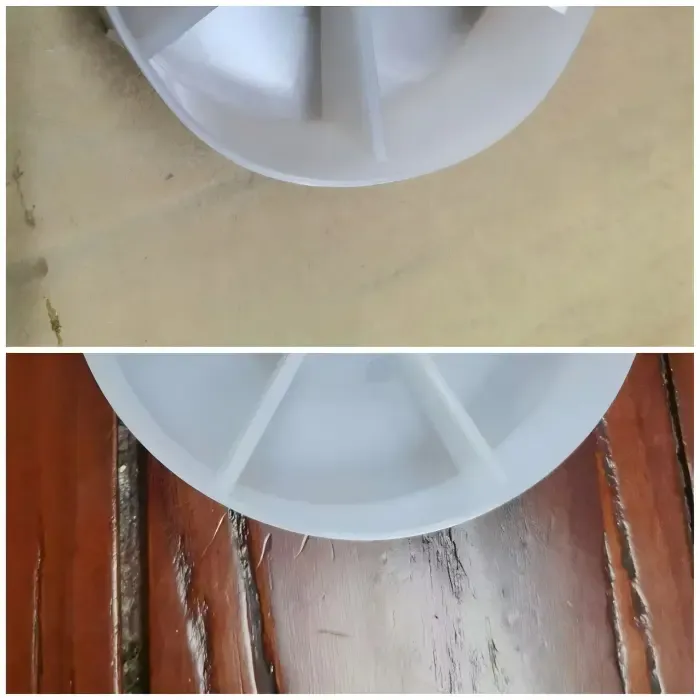
Critical Quality Control: Samples on the left show greyish contamination due to barrel residue; samples on the right show pristine results after a 100% system purge.
3. Cracking the "Ovality" Code: Advanced Thermal Balancing
As we pushed the cooling time down, the part warped into an oval. Standard water cooling failed to handle the heat load of the hot runner.
The JST Solution: We hooked the entire mold to a high-performance industrial chiller set to 5.0°C.
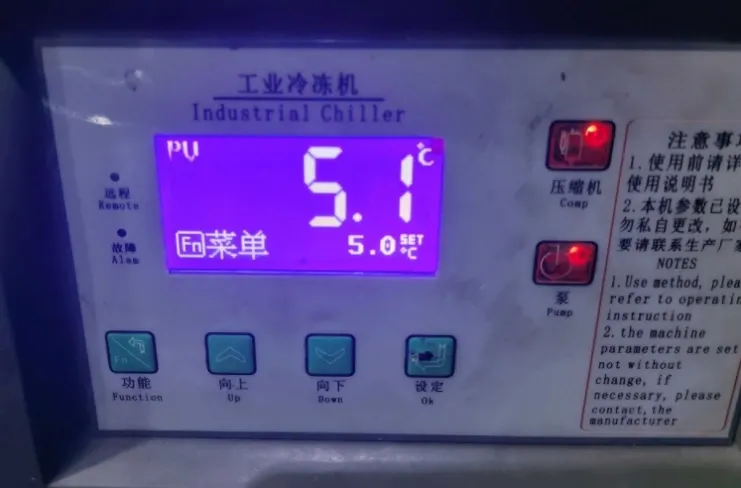
Aggressive Cooling Logic: Industrial chiller stabilized at 5.0°C (Set Point) to find the absolute physical limit of the HDPE cooling rate.
The "Sweat Test": Thomas carefully balanced the actual surface temperature to avoid atmospheric condensation (sweating), reaching the physical limit of heat extraction:
- Core Temp (Actual): 21.0°C
- Cavity Temp (Actual): 23.5°C

Precision Balancing: Multi-zone hot runner management at 180°C, isolated from the chilled mold base to prevent material degradation.
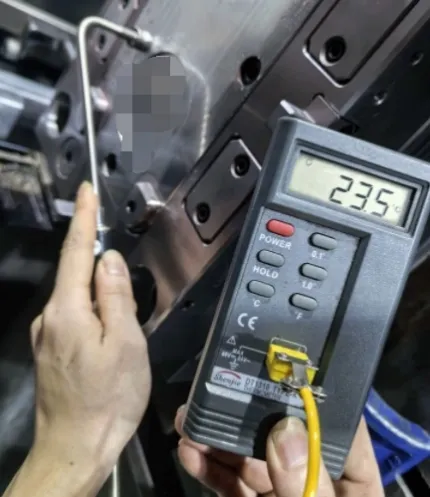
On-Site Verification: Handheld thermocouple confirming an actual cavity surface temperature of 23.5°C, ensuring zero thermal drift during the 23s cycle.
4. Data Evidence: Performance Comparison Table
Here is the hard data from the Haitian 160T trial:
Metric | T1 Baseline | JST Final T2 Result | Improvement |
Cooling Method | Standard Water | 5.0°C Chilled Water | Extreme Heat Extraction |
Core Surface Temp | 34.0°C | 21.0°C | -13.0°C |
Injection Time | 6.1 s | 3.0 s | -50% |
Holding Time | 8.0 s | 5.0 s | -37% |
Cooling Time | 25.0 s | 4.0 s | -84% |
Total Cycle Time | 45.0 s | 23.5 s | 48% Reduction |
Part Roundness | Warped/Oval | Perfect Circle | Pass CMM |

Process Stability Record: Stabilized Haitian 160T monitor data tracking the leap from a 45s benchmark to a consistent 23.5s production cycle.
5. The Business Impact
We delivered a 95% increase in production capacity. The mold received immediate sign-off and was air-freighted the next day. We didn't just deliver a tool; we delivered a competitive edge.

Mission Accomplished: Precision tool secured in reinforced export-grade crating, air-freighted to Europe within 24 hours of T2 approval.
6. Challenge Our Engineers With Your Toughest Project
Are you tired of mold suppliers who give you "estimated" cycle times that fail in production? At JST Mould, we use data-driven Scientific Injection Molding to guarantee performance.

Request a Free DFM & Cycle Time Analysis]