
Engineering Whitepapers
Addressing Localized Cooling Issues During T1 Trials
A real POM component T1 case showing how JST responded to localized cooling concerns through customer discussion and an engineering design review.
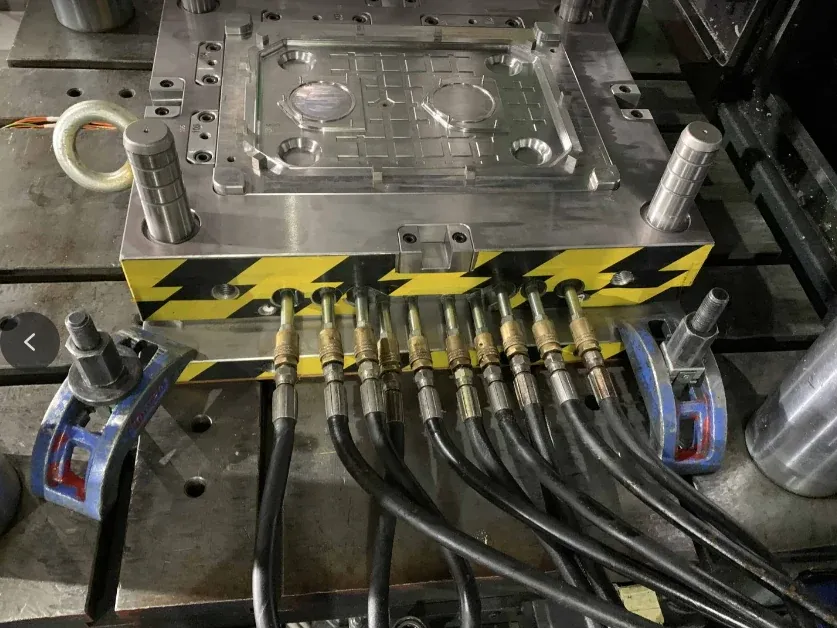
A localized cooling concern during a first mold trial can create uncertainty for both the tooling team and the customer. The part may look broadly acceptable while one specific area does not cool as expected. Before deciding whether the issue comes from part geometry, mold design or process conditions, the team needs to identify the affected region and agree on what should be checked next.
A JST project involving a POM outlet upper component provides a practical example of this early-stage engineering challenge. During the T1 trial, insufficient cooling was reported in an oval area near the center of the molded sample. JST discussed the issue with the customer in a video meeting and arranged for an engineer to review and modify the design.
The available project record confirms the concern and JST's response. It does not establish the exact root cause, the specific design change, or the final validation result. Those boundaries matter: a responsible case study should distinguish an engineering response from a verified successful outcome.
What was the project context?
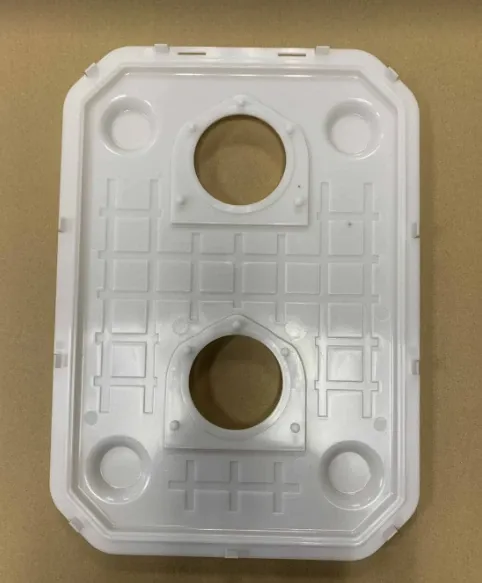
The project involved an outlet upper component molded in POM. The internal T1 trial record identifies the resin as Hostaform C9021 (Ticona) and records a part weight of 306.3 g. The component has several molded geometric features, including circular openings and raised areas.
These details provide context for the trial, but they do not by themselves explain the cooling concern. A product photograph can show the part's visible geometry; it cannot establish the internal mold cooling layout, local steel temperature or the cause of a thermal imbalance.
For confidentiality, internal part and mold identifiers and the exact historical trial date are not included in this public case description.
Why does a localized cooling concern need careful diagnosis?
Cooling behavior is influenced by the relationship between part geometry, material behavior, mold construction and process conditions. A localized area may cool differently from the surrounding part when its geometry or local thermal path differs. However, that is a general engineering possibility—not a confirmed diagnosis for this project.
For a real investigation, engineers may need to review:
- Local and surrounding wall sections, ribs, bosses and transitions in the 3D part model.
- The position of the reported area relative to the mold core and cavity.
- Cooling-channel locations, circuit layout and access constraints.
- The material grade and the processing information recorded during the trial.
- The actual symptom: whether the concern relates to surface temperature, part ejection, deformation, dimensional variation or another observed condition.
These checks help separate a cooling-system issue from other causes that can produce similar symptoms. Without the relevant drawings, temperature observations and trial records, it would be premature to assign a root cause.
How did JST respond during the T1 stage?
The confirmed project response had two parts. JST discussed the localized cooling concern with the customer in a video meeting, then arranged for an engineer to modify the design.
This sequence is important in a tooling project. A T1 concern should be communicated in a way that allows the customer and engineering team to identify the affected feature, review the available evidence and agree on the next engineering action. A design change should be based on the actual part and mold data rather than on an assumption drawn from a photograph alone.
The available records do not specify the exact design feature that was changed. They also do not confirm whether the planned modification was completed. This case therefore does not attribute a particular cooling-channel revision, insert change, material change or process adjustment to JST.
What should be checked before accepting a design change?
For a localized cooling concern, the engineering review should connect the symptom to a defined location and a testable verification plan. Depending on the actual mold and part, a review may consider the local geometry, cooling access, circuit arrangement, mold temperature observations and process records.
Before approving a change, the project team should agree on:
- The precise location and repeatable description of the symptom.
- The drawing or 3D model revision being reviewed.
- The proposed design change and its expected engineering purpose.
- Any impact on mold structure, machining, maintenance or other part features.
- The trial conditions and observations that will be used to evaluate the change.
These are general review principles, not a description of undocumented steps from the historical project. Their purpose is to prevent a design adjustment from being treated as successful merely because a change was proposed or made.
What is known about the result?
The evidence available for this case confirms that the localized cooling concern was raised during T1, that JST discussed it with the customer, and that JST arranged an engineering design modification.
The evidence currently available does not confirm the exact modification, its completion, a subsequent trial, or a measured improvement. No cycle-time reduction, temperature change, dimensional result or final customer acceptance is claimed here.
For procurement and engineering teams, this distinction is useful. When reviewing a tooling supplier's case history, ask whether the supplier can show the original observation, the engineering change record and the post-change validation—not only a statement that the issue was addressed.
What should buyers prepare when a similar issue appears?
A clear engineering review starts with enough information to identify and reproduce the concern. If a localized cooling issue appears during a mold trial, prepare:
- The 3D part file and latest controlled 2D drawing.
- Resin manufacturer and exact material grade.
- The trial stage and available process record.
- A photograph identifying the affected area, with the location marked.
- Any temperature readings, dimensional measurements or repeatability observations already available.
- Relevant mold drawings or cooling-circuit information, where disclosure is permitted.
- The expected production requirement and the acceptance criteria for the affected feature.
JST's work in injection mold design and manufacturing can be explored through its precision injection mold manufacturing solutions. This is a general service relationship, not a claim that the linked showcase page depicts the historical POM project or its specific mold.
FAQ
Does a localized cooling concern always mean the cooling channels are incorrectly designed?
No. Cooling-channel layout is one possible factor, but the symptom should be assessed alongside part geometry, local wall sections, material behavior and recorded process conditions. The cause should not be assigned without project-specific evidence.
Can a T1 trial identify cooling-related risks?
A T1 trial can reveal concerns that need further engineering review. The observation should be recorded with a clear location and supporting evidence. Whether the issue is resolved requires an agreed follow-up check and documented result.
What information should be sent for an engineering review?
Provide the latest 3D model and drawing, resin grade, trial observations, marked photographs, relevant process records and any available mold cooling information. Critical dimensions and acceptance requirements are also useful.
Can a mold design change be considered successful as soon as it is completed?
No. A design change is an intervention, not proof of an outcome. The team should evaluate the revised tool under agreed trial conditions and record the relevant observations or measurements before accepting the change.
Can JST review a cooling concern before a new tooling quotation?
Customers can submit project information for an initial engineering and DFM discussion. The scope of any review should be agreed, and conclusions depend on the drawings, material information and evidence available.
Have a localized cooling concern during a mold trial? Contact JST for an engineering discussion and injection mold RFQ. Share your 3D part file, resin grade, marked trial photographs, available process records and the specific area of concern so the team can understand the project requirements.