
Sep 13, 2026Engineering Whitepapers
Injection Mold Design Guidelines: Practical Lessons from Our 230-Experience Series – Part 3
Practical injection mold design guidelines covering gating, ribs, tolerances, cooling, hot runners, automation and mold validation, based on real tooling experience.
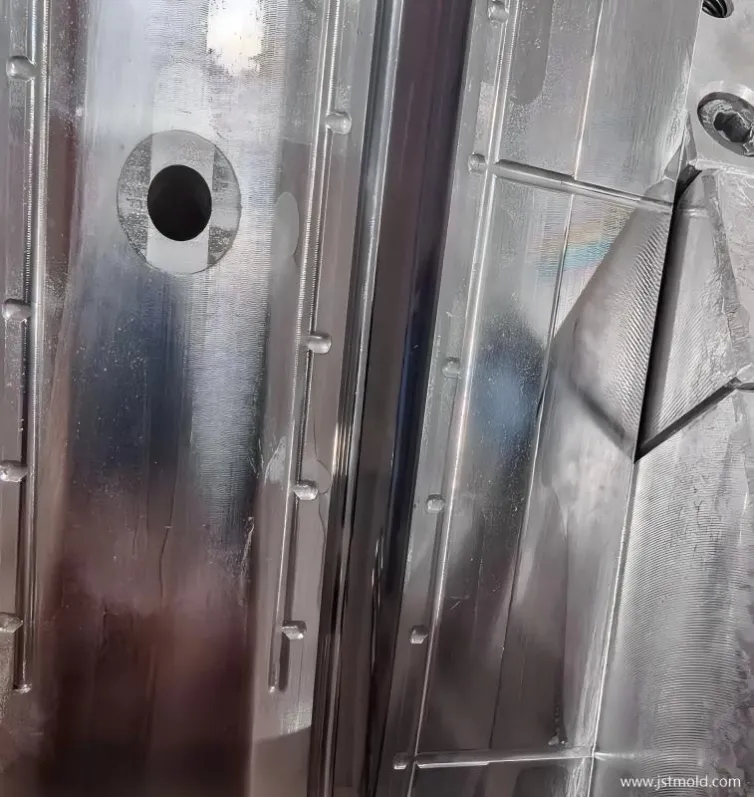
Injection Mold Design Guidelines: Practical Lessons from Our 230-Experience Series – Part 3
Good injection mold design is not about applying one formula or one standard. Mold performance depends on how part geometry, resin, gating, steel, cooling, ejection, automation, and inspection requirements work together.
This is Part 3 of JST Mould’s 230 mold design experience series, based on lessons from mold design, machining, trials, troubleshooting, and production support.
The values below are practical engineering references, not universal limits. Final decisions must still be checked against the actual resin grade, part geometry, mold structure, surface requirement, molding machine, expected tool life, and customer specification.
1. Surface Finish, Polishing and Gate Design
Mirror Polishing Requires Machining Allowance
For high-gloss or optical mold surfaces, polishing must be considered before final machining.
In one practical design reference, a surface finish around Ra 0.05 μm was paired with approximately 0.03 mm of polishing allowance before final finishing.
Ra 0.05 μm and 0.03 mm are practical project references, not universal mold standards.
The exact allowance depends on steel grade, hardness, machining condition, heat treatment, and the required surface quality. If too little material is left, polishing may not remove the previous machining marks. If too much is removed, geometry can change.
High-gloss mold surfaces require polishing allowance to be considered before final machining.
Gate Location Affects Both Filling and Appearance
Gate design affects more than flow.
For appearance-sensitive parts, a submarine or tunnel gate can help move the gate witness away from the main cosmetic surface. But gate location must still be checked against resin behavior, shear, gate freeze, automatic degating, flow direction, and the acceptable gate vestige.
A gate that is easy to hide is not necessarily a good gate.
Burn Marks Are Not Always a Processing Problem
Reducing injection speed or pressure may help with some burn marks, but repeated defects in the same position often point back to the mold.
Typical causes include trapped air, insufficient venting, restrictive gates, deep ribs or bosses near the end of fill, and excessive local shear.
If the same burn mark keeps returning, review the mold before narrowing the process window.
2. Dimensions, Tolerances and Metrology
Read the Part Drawing Before Designing the Mold
A mold can reproduce the cavity accurately and still produce a part that fails assembly.
Before mold design begins, identify the main datums, functional dimensions, assembly interfaces, sealing surfaces, cosmetic areas, deformation-sensitive features, and the dimensions that will be checked during mold acceptance.
Tolerance planning should begin before steel is cut, not after the first CMM report.
CMM Inspection Should Follow the Same Datum Logic
CMM accuracy alone does not guarantee useful data.
Fixture condition, part orientation, probe direction, and datum definition can all influence the result, especially on flexible plastic parts.
The drawing, molded part, fixture, and inspection program should use the same reference system. Otherwise, a measurement disagreement can look like a molding problem even when the physical part has not changed.
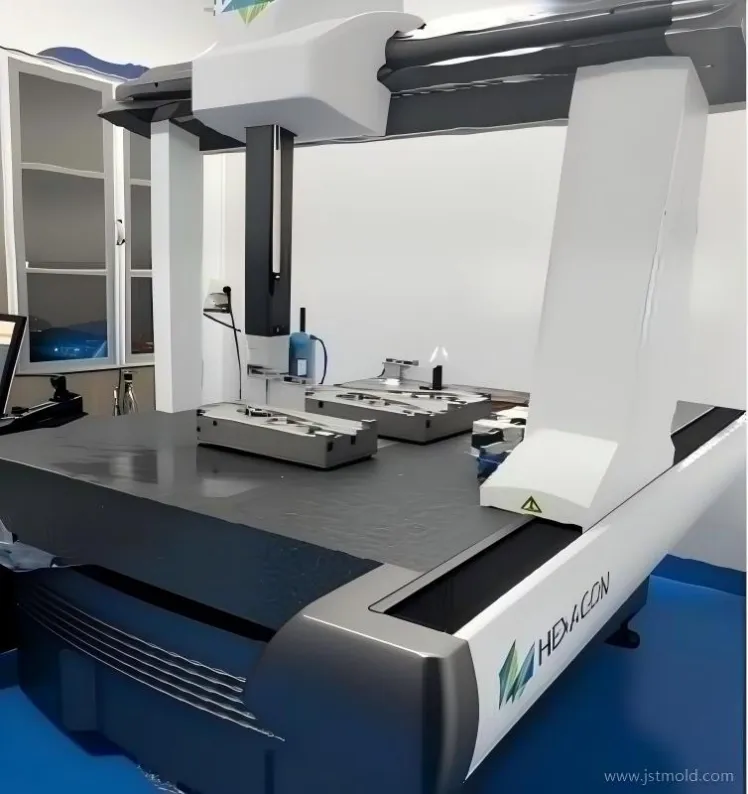
CMM results are most useful when the drawing, fixture and inspection program follow the same datum strategy.
Validate Repeatability, Not One Good Part
One acceptable sample does not prove mold stability.
For important dimensions, multiple consecutive molded parts are more meaningful than selecting the best sample from the trial.
Three consecutive shots, for example, can already show whether the process is repeating consistently.
For higher-risk parts, validation may also compare different cavities, trial periods, or production conditions.
The real question is not whether the mold can produce one good part. It is whether it can produce acceptable parts repeatedly within a realistic production window.
Project Example – When Process Adjustment Was Not Enough
In one European structural-part project, T1 samples showed approximately 1.8 mm of edge bow. CMM and trial data indicated that the problem was driven mainly by geometry and differential shrinkage rather than a single machine setting.
The correction therefore focused on inverse CAD mold pre-deformation together with DOE-based validation, rather than repeatedly adjusting molding parameters. After tool modification and structured validation, the part reached full flatness compliance and received customer release.
The correction focused on inverse CAD mold pre-deformation and DOE-based validation rather than repeated machine-setting changes.
3. Wall Thickness, Ribs, Flow and DFM
Rib Thickness Should Follow the Nominal Wall
Ribs increase stiffness without thickening the whole part, but oversized ribs can create sink marks, shrinkage differences, and distortion.
As a practical starting point, our design references commonly evaluate rib thickness at around one-half to two-thirds of the nominal wall thickness, depending on resin, rib geometry, and surface requirements.
This is not a fixed rule. Final rib design should also consider reinforcement level, rib height, draft, cooling, local wall thickness, and the cosmetic surface on the opposite side.
A rib that works well in unfilled ABS may behave very differently in PA66-GF30.
For a detailed explanation of thick-section shrinkage, see our sink marks and internal voids guide.
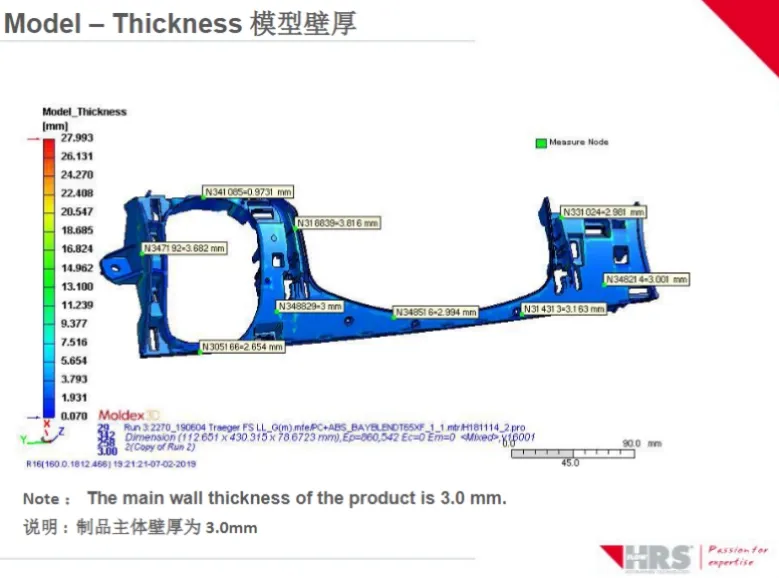
Rib and boss dimensions should be evaluated relative to the surrounding nominal wall and material behavior.
Flow Length Must Be Evaluated With Wall Thickness
The flow-length-to-thickness ratio, or L/t ratio, is useful during early DFM evaluation, particularly on long or thin parts.
But L/t alone cannot determine whether a cavity will fill.
Filling also depends on resin viscosity, mold and melt temperature, gate size and location, pressure loss, local restrictions, fiber content, and machine capability.
For difficult geometries, early flow analysis can show whether the better solution is to change the gate, adjust local wall thickness, shorten the flow path, or modify another feature before tooling begins.
Bosses, Grooves and Local Features Need Context
Many mold-design rules were originally recorded together with sketches.
Ratios involving dimensions such as a, b, c, and t should not be reused unless the original geometry is clear.
The broader rule remains useful: bosses, grooves, ribs, and pockets should be designed relative to the surrounding wall instead of as isolated heavy sections.
This helps reduce sink marks, hot spots, warpage, differential shrinkage, and unnecessary pressure demand.
4. Material and Mold Steel Decisions
Resin Behavior Affects Final Dimensions
Molding shrinkage, crystallinity, moisture absorption, fiber orientation, and thermal expansion are different effects.
A datasheet shrinkage value is useful during early design, but final dimensions may also be influenced by gate location, packing, wall thickness, flow direction, and part geometry.
For reinforced materials, directional shrinkage and warpage may become as important as the nominal shrinkage value.
Mold Steel Should Match the Main Project Risk
There is no single best mold steel.
Selection should reflect abrasive wear, corrosion, polishing requirements, heat-treatment stability, repairability, expected tool life, and maintenance strategy.
A steel suitable for a cosmetic housing may not be suitable for a high-volume mold running abrasive glass-filled material.
Detailed grade comparison belongs in a dedicated mold steel selection review. The key design point here is that steel selection should follow the actual production risk, not shot count alone.
For a detailed comparison by resin, tool life and surface requirement, see our mold steel selection guide.
Special Insert Materials Should Solve a Defined Problem
High-conductivity inserts can help where conventional steel and drilled cooling cannot remove heat efficiently from a local hot spot.
Their use should still consider wear, strength, support, surface treatment, and repairability.
A special insert material should solve a real thermal or mechanical problem—not simply make the mold specification look more advanced.
5. Automation and Production-Ready Mold Design
Robot and EOAT Clearance Must Be Checked Before Steel Is Cut
A part can eject correctly and still fail in automatic production.
For robot take-out, the 3D mold review should include opening stroke, tie-bar clearance, gripper width, part orientation, runner pickup, slides and lifters, ejector position, and the robot approach and withdrawal path.
A small interference found during commissioning can become an expensive mold modification.
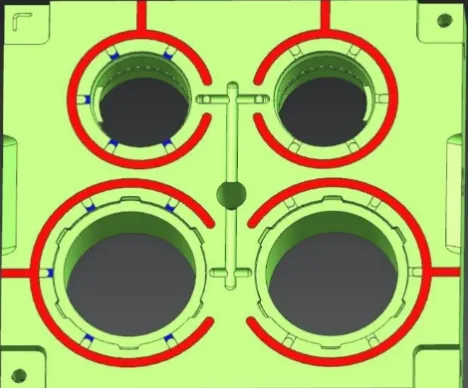
Robot and EOAT clearance should be checked before the mold layout is frozen.
Mold Change Time Starts With Interface Design
Fast mold changes depend partly on how the mold connects to the production cell.
Important details include standardized water connections, accessible electrical and hydraulic interfaces, clear inlet/outlet identification, hot-runner connections, lifting points, locating features, and clamping access.
For export molds, this matters even more because the moldmaker may not be present when the customer installs the tool.
Automatic Degating Must Be Repeatable
Automatic degating should be checked for repeated production, not just one successful trial.
The designer needs to consider where the gate breaks, gate vestige, runner retention, part deformation, small runner fragments, and robot or conveyor handling.
For cosmetic or optical parts, whitening, stress marks, and gloss variation must also be checked.
Mold Rigidity Matters Under Real Loads
Large cavity openings, manifold pockets, long unsupported spans, and high cavity pressure can all cause plate deflection.
Support pillars, backing plates, interlocks, and local reinforcement should follow the actual load path.
Even small movement can affect parting-line sealing, slider alignment, cavity dimensions, and hot-runner sealing.
Cavity Pressure Sensors Can Support Validation
Cavity pressure data can help identify filling imbalance, transfer inconsistency, packing variation, gate freeze, and process drift.
Sensor position matters. A reading near the gate tells a different story from one near the end of fill.
For demanding programs, cavity pressure can support a broader scientific mold trial and acceptance strategy.
6. Cooling, Ejection and Mold Construction
Cooling Design Must Solve the Actual Hot Spot
Cooling affects cycle time, warpage, dimensional stability, and surface quality.
Where drilled water channels cannot reach a critical area, options may include high-conductivity inserts, bubblers, baffles, thermal pins, localized inserts, or conformal cooling.
The best solution depends on the geometry and thermal problem.
Project Example – Local Thermal Control in a Warpage-Critical Tool
In a European structural-part project with glass-filled resin, conventional cooling alone could not maintain the required temperature balance across a long, thin cavity.
High-conductivity copper-alloy inserts were used selectively in the high-heat zones, where conventional cooling channels could not remove heat efficiently enough. The inserts supported the corrected mold geometry and helped maintain a stable thermal condition during DOE-based validation.
Cooling Conditions Should Match the Customer's Plant
A mold that performs well during the moldmaker's trial can behave differently if the customer's water temperature, flow rate, pressure, or connection standard changes.
For export tooling, the intended temperature-control conditions should be reviewed before the cooling system is finalized and included in the technical handover.
Slider Retreat Usually Points to a Locking Problem
If a slider moves backward under injection pressure, review the locking system.
Possible causes include insufficient heel-block support, poor locking angle, excessive clearance, deformation, wear, or weak force transmission.
Injection pressure should be transferred into a rigid support path instead of pushing the slider away from its intended position.
Micro Features Must Match a Real Manufacturing Route
Very small mold features may require fine wire EDM, small-hole EDM, laser drilling, or another specialized process.
These are process-specific references, not universal manufacturing limits.
Before freezing a micro feature, confirm how it will be machined and inspected.
Blade Ejectors Need Strength and Guidance
Blade ejectors are useful where conventional pins cannot fit, but their thin section makes them more sensitive to bending, wear, flash, and seizure.
A practical reference around 0.5 mm blade thickness may be possible in selected applications, but final dimensions depend on unsupported length, steel, heat treatment, ejecting force, side load, and travel.
The goal is not to use the thinnest blade possible. It is to use the smallest blade that can operate repeatedly with adequate strength and guidance.
7. Hot Runner Design and Thermal Expansion
Select the Runner System Around the Application
Full hot-runner, hybrid, and insulated-runner systems each have different strengths and limitations.
Selection should reflect resin, shot size, production volume, gate location, appearance requirements, maintenance, and the customer's production environment.
The runner system should be part of the mold architecture from the beginning.
Hot Runner Thermal Expansion Must Be Designed In
A hot-runner manifold is assembled cold but operates at a much higher temperature.
That temperature rise causes the manifold and related components to expand.
Nozzle position, manifold length, support, sealing interfaces, and plate geometry must account for the difference between the cold assembly condition and the hot operating condition.
Ignoring this movement can contribute to nozzle misalignment, abnormal contact load, sealing problems, manifold stress, or leakage.
Hot runner layout must account for the difference between the cold assembly condition and the hot operating condition.
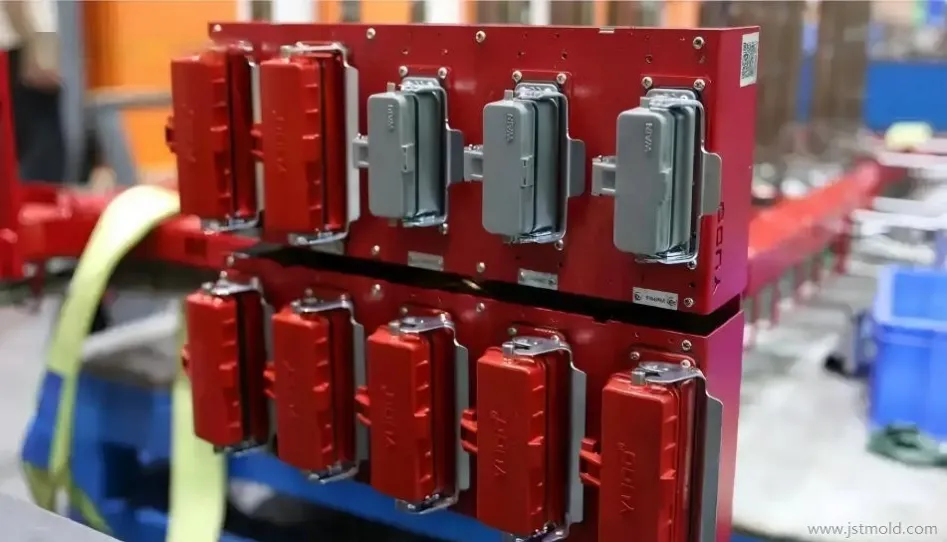
Hot runner reliability depends on both thermal expansion control and adequate structural support.
Valve Gate Sequencing Is a Flow-Control Decision
Valve-gate sequencing can influence weld-line position, pressure distribution, hesitation, filling balance, and surface appearance.
For complex molds, sequencing should be supported by Moldflow analysis or equivalent flow evaluation rather than decided by gate spacing alone.
Manifold Support Affects Hot Runner Reliability
A large manifold pocket removes material from the mold plate and can reduce local stiffness.
If support is insufficient, plate deflection can affect hot-runner sealing.
Hot-runner design is therefore also a structural mold-design problem.
8. Optical and High-Precision Tooling
Optical Parts Need More Than a Polished Cavity
Optical and high-gloss parts can be sensitive to gate position, flow marks, runner balance, polishing direction, cooling, and local stress.
A cavity can look perfectly polished and still produce an unacceptable optical part if filling or cooling is unstable.
Fine Geometry May Require Precision Grinding or EDM
High-precision inserts may contain radii, narrow slots, or cylindrical features that cannot be finished reliably with ordinary milling.
Grinding, wire EDM, or other precision processes may be required.
In one practical reference, dimensional control in the few-micron range was considered for selected features.
The specified tolerance must still match both manufacturing and inspection capability.
Flatness and Parallelism Can Become Critical
One practical optical-tooling reference includes a very small mm-level flatness/parallelism requirement.
A tolerance at this level depends on the entire process chain: material, heat treatment, machining, grinding or polishing, temperature control, and inspection.
It should never be applied as a generic mold-design number.
Newton Rings Can Help Reveal Optical Surface Error
Newton rings can appear when two optical surfaces are placed close together and the air gap varies across the surface.
The interference pattern can help reveal differences in flatness or surface form.
For optical tooling, this provides a useful verification method alongside conventional dimensional inspection.
9. Maintenance, Sampling and Quality Control
Maintenance Frequency Depends on the Tool
Complex molds with many slides, lifters, inserts, or wear surfaces may need more frequent inspection than simple tools.
An initial inspection interval around 10,000 shots may be used in some complex tools, while simpler molds can often run substantially longer.
Actual maintenance frequency should depend on material, fillers, lubrication, mold structure, production conditions, and observed wear.
Surface Finishing Should Follow Function
Not every mold surface should be polished as smooth as possible.
Finishing requirements depend on whether the surface is cosmetic, sealing, optical, textured, or purely dimensional.
Over-polishing can round edges, alter shut-offs, or change geometry.
Heat Treatment Requires Finish-Machining Allowance
Heat treatment can introduce dimensional change or distortion.
Where tight final dimensions are required, material should be left for finish grinding or machining after heat treatment.
One practical reference uses approximately 0.10–0.20 mm of allowance in selected applications.
The exact value depends on steel grade, geometry, heat-treatment route, and required tolerance.
Frequently Asked Questions
What are the most important factors in injection mold design?
The most important factors are part geometry, resin, expected production volume, target mold life, dimensional tolerances, surface requirements, gating, cooling, ejection, molding-machine conditions, automation, and validation requirements.
These factors should be evaluated together. A design change that improves one area can create a problem somewhere else.
Can the same mold design rules be used for every plastic material?
No.
Different materials behave differently in flow, shrinkage, moisture absorption, wear, cooling, fiber orientation, and dimensional stability.
A design guideline that works well for ABS may need to be adjusted significantly for POM, PC, PA66-GF30, or another engineering resin.
When should Moldflow analysis be used before mold manufacturing?
When should Moldflow analysis be used before mold manufacturing?
Moldflow or equivalent flow analysis is particularly useful when the part has long flow paths, thin walls, multiple gates, valve gates, appearance-critical surfaces, expected weld-line problems, or high pressure demand.
The goal is to identify filling and packing risks before steel is cut.
When should automation requirements be included in mold design?
Before the mold layout is frozen.
Robot access, EOAT clearance, insert loading, automatic degating, part orientation, mold opening stroke, and machine interfaces can all affect the mold structure.
Adding these requirements after machining has started can lead to expensive modifications.
What should a moldmaker review before starting mold design?
For an effective DFM and tooling review, the moldmaker should understand the 3D part model, 2D drawing and critical tolerances, resin grade, annual volume, target mold life, molding-machine information, cosmetic requirements, automation requirements, and the customer's validation or acceptance criteria.
The more clearly these requirements are defined before design freeze, the lower the risk of major changes later.
Before Steel Is Cut, Review the Design Risks
Many mold problems become expensive because they are discovered too late.
Before the mold design is frozen, JST Mould can review the part for gating and filling, parting-line and shut-off risks, wall and rib geometry, cooling, ejection, tooling materials, automation clearance, critical dimensions, and expected production conditions.
Send Your Part Data for a DFM Review
For an initial review, you can provide:
- 3D part data;
- 2D drawing, if available;
- resin grade;
- expected annual volume;
- target mold life;
- molding-machine information, if known;
- and any critical cosmetic or dimensional requirements.
We can then review the tooling approach before steel is cut and identify the main points that should be discussed during quotation and DFM.